
Standard TV Unit Height Guide: Ideal Height, Size and Dimensions
When you stand in your living room with a tape measure and find you have no idea how tall the cabinet should actually be, selecting a TV unit seems deceptively easy. If it’s too high, your neck will hurt after twenty minutes. The screen feels buried behind the couch because it is so low. The configuration appears dangerously top-heavy and is too narrow.
The purpose of this guide is to completely eliminate that guesswork.
The typical TV unit height, the reasoning behind TV unit dimensions, a detailed breakdown of TV unit size by screen size, and actual measurements from the ELVM Homes collection are all provided below so you may compare genuine products to your room before making a purchase.
What is the typical height of a television unit?
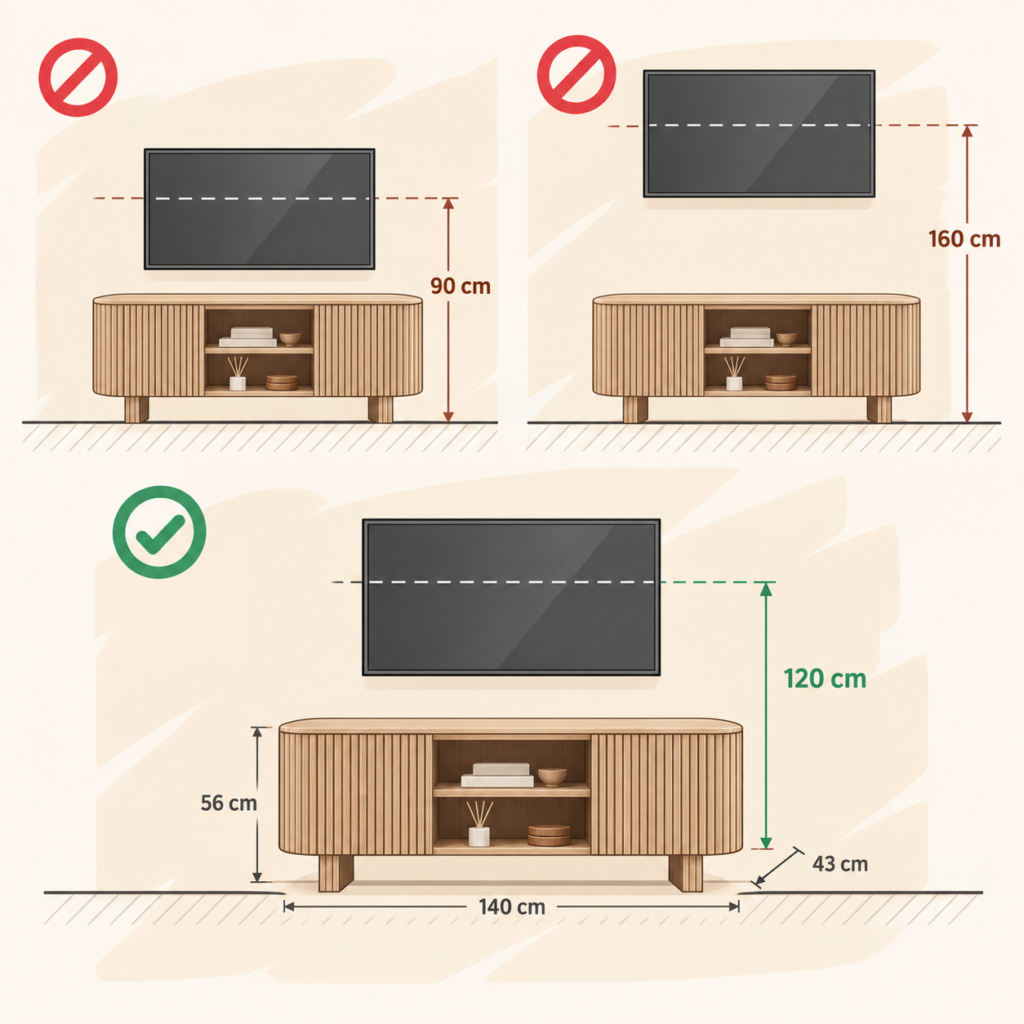
- The typical height of a TV unit in a living room is between 45 and 65 cm (18 and 26 inches) from the floor to the top surface of the cabinet. This range places the center of a standard television screen at or close to the eye level of the sitting viewer, which is the most crucial aspect of comfortable watching.
- Because the “correct” height varies based on your sofa’s height, the actual dimensions of your TV, and whether the screen is mounted on the wall above it or on the cabinet, there isn’t a single universal figure.
As a useful standard:
- Low-profile units (45–50 cm/18–20 inches): Ideal for spaces with low-slung contemporary sofas or larger TVs (65″) where the screen itself significantly increases vertical height.
- The most adaptable range is the mid-range units (50–60 cm/20–24 inches). works nicely with conventional sofa heights and televisions ranging from 43″ to 55″. This category includes the majority of the ELVM Homes collection.
- Taller units (60–65 cm/24–26 inches): Ideal for rooms with higher chairs or smaller TVs (32″–43″) where a taller cabinet raises the screen to eye level without requiring wall attachment.
Key Takeaway: Your storage needs should always come second to your seated eye level when determining the height of your TV cabinet, never the other way around.
Why TV Unit Height Is More Important Than Depth or Width
The bulk of purchasers spend most of their time evaluating the width of TV units to see if they will fit on the wall. When placed next to the sofa, will it appear proportionate? These are legitimate concerns, but height is the factor that directly impacts your daily level of physical comfort.
Eye-Level Viewing's Ergonomics
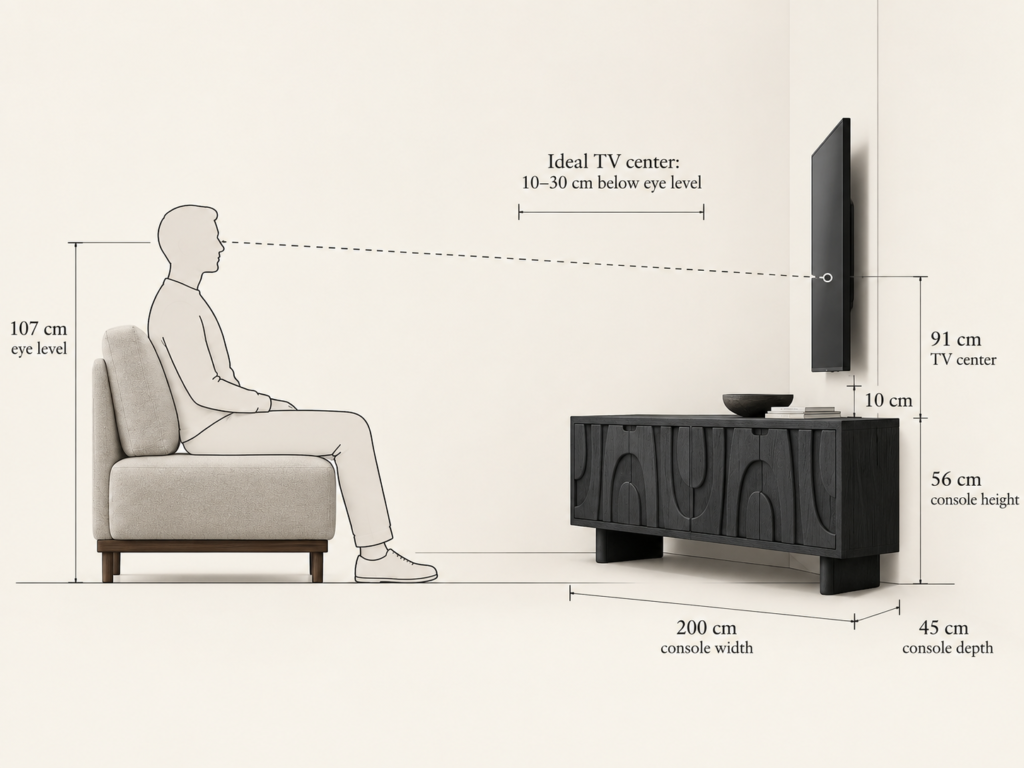
- Your eyes normally rest between 91 and 107 cm (36 and 42 inches) from the floor when you’re sitting on your couch. The natural sight line should be as close to the center of your TV screen as feasible.
- Your neck tilts upward if the center of the screen is far higher than eye level. This causes persistent headaches, shoulder stiffness, and neck stress over weeks and months; it’s similar to the strain you get from sitting in the front row of a movie theater.
- Your posture collapses forward and your chin sinks if the screen center is positioned too much below eye level, which is similarly uncomfortable during prolonged viewing periods.
- The variable that can be adjusted to put the screen into the ergonomic sweet spot is the height of the TV stand. If you do it correctly, you won’t think about it again. If you do it incorrectly, you will experience discomfort every night.
The Impact of Height on Room Dimensions
Beyond comfort, the TV unit’s height from the floor affects the wall’s overall balance. A boxy, bottom-heavy appearance is produced by a cabinet that is abnormally tall for the television above it. A TV may appear to be hovering awkwardly with an excessive amount of empty space between the console and the display if it is positioned too low beneath a huge screen.
The cabinet height, screen size, and wall space above and surrounding the arrangement are all clearly related in the most aesthetically pleasing configurations.
How to Determine the Perfect TV Unit's Floor Height
Start with this formula:
Seated Eye Level minus half of TV Height equals the ideal TV unit height.
Here’s how to implement it in your own living room, step-by-step:
Step 1: Determine Your Eye Level While Seated
Take a seat on your couch in the way you often watch TV on a Tuesday night that is, without slouching or sitting up straight. Ask someone to take a vertical measurement from the floor to your eye level. This ranges from 91 to 107 cm (36 to 42 inches) for the majority of adults on a typical sofa.
Step 2: Determine the Height of Your TV
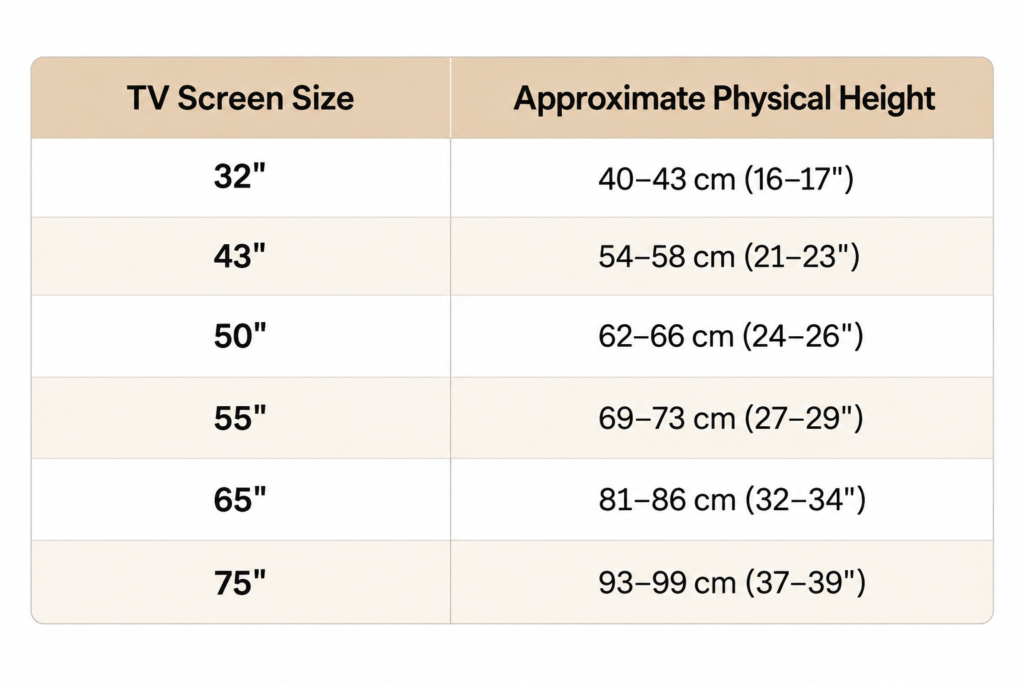
Take a measurement from the bottom edge to the top edge of your television to determine its real outer height. Avoid using the diagonal screen size since it provides no information about the actual height. For reference:
TV Screen Dimensions Relative to Height
Step 3: Locate the Screen Center
The physical height of the TV is divided by two. The center point of a 55-inch TV that is 71 cm tall is 35.5 cm.
Step 4: Determine the Optimal Stand Height
Deduct the center of the screen from your eye level while seated. If the distance between your eyes is 100 cm:
100 cm minus 35.5 cm equals 64.5 cm.
After accounting for the TV’s own stand or feet, the top surface of the cabinet should be about 28–30 cm below the optimal TV console height of 64–65 cm from the floor to the TV center.
Step 5: Take Real-World Variables Into Account
Consider the computed figure as a starting point rather than a strict guideline. Adjust according to:
The height that the feet or pedestal of your TV contribute (usually 2–8 cm)
Whether the TV will be installed above the unit on the wall (greater freedom)
Positioning the soundbar on the cabinet’s surface (adding 5–10 cm of height)
The stiffness of the cushions and the height of the seats on your sofa
Your normal sitting position (reclined vs. upright)
The distance between the screen and the couch
Because the screen’s weight is no longer supported by the cabinet, the TV unit height from the floor becomes more flexible for wall-mounted televisions. In this configuration, the visual ratio between the console below and the floating screen is just as important as the actual measurements.
Explanation of Standard TV Unit Dimensions: Width, Depth, and Height
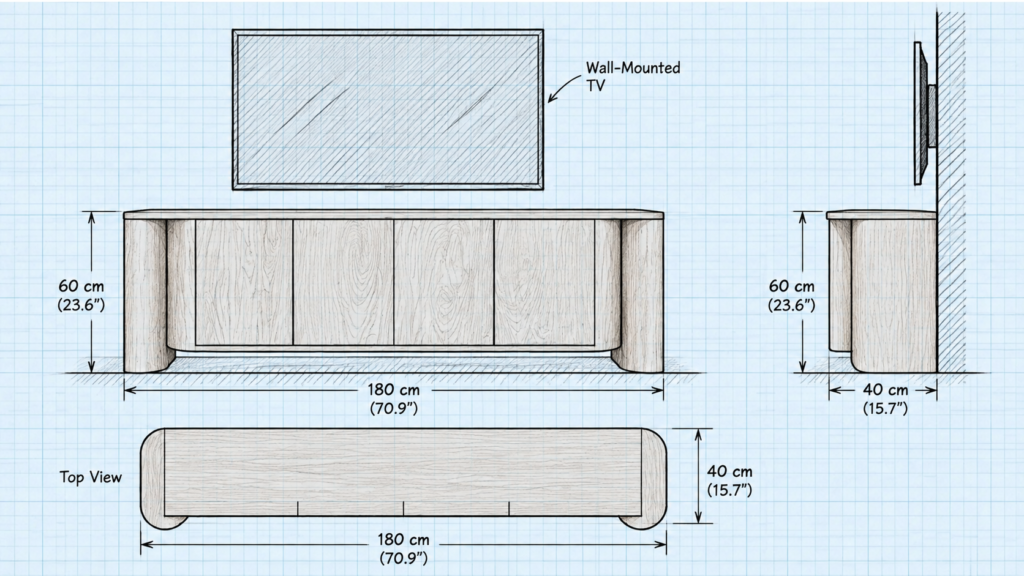
Three metrics are used to define the dimensions of a standard TV unit: width (length), depth, and height. Because TV sizes, room layouts, and storage requirements differ from home to home, there isn’t a single universal standard size for TV units. However, the most typical dimensions for contemporary living rooms are 45–65 cm tall, 35–50 cm deep, and 120–210 cm broad.
It is much easier to compare designs when you know what each dimension regulates.
TV Unit Length (Width)
The width of the cabinet is measured horizontally from one end to the other. Because it decides whether the unit fits your wall and appears proportionate beneath your television, it is the dimension that most buyers pay the most attention to.
The Golden Rule states that your TV unit should extend at least 10 to 15 cm (4 to 6 inches) on each side beyond the TV’s outside edge. This keeps the layout from appearing top-heavy and gives visual breathing room.
TV Dimensions TV Width Unit Width Optimal Unit Width
| TV Size | TV Width (Approx.) | Minimum Unit Width | Ideal Unit Width |
|---|---|---|---|
| 32″ | 71 cm (28″) | 91 cm (36″) | 102–120 cm (40–47″) |
| 43″ | 96 cm (38″) | 117 cm (46″) | 120–140 cm (47–55″) |
| 55″ | 122 cm (48″) | 142 cm (56″) | 150–180 cm (59–71″) |
| 65″ | 145 cm (57″) | 165 cm (65″) | 180–200 cm (71–79″) |
| 75″ | 168 cm (66″) | 188 cm (74″) | 200–216 cm (79–85″) |
Don’t pick a larger unit just because the wall is big. The key to keeping a living room looking spacious rather than cramped is to leave open space around the furnishings.
TV Unit Depth
The TV unit’s depth, which is measured from the front edge to the back, is the parameter that most customers ignore and that leads to the most annoyance after delivery.
When the TV rests directly on the cabinet, depth becomes crucial. Make sure the surface can support the following before placing an order:
TV feet or pedestal base, which is typically 20–30 cm deep
Soundbar (depth of 8–12 cm)
streaming device or set-top box (15–20 cm deep)
console for gaming (20–28 cm deep)
Wi-Fi router (depth of 12–15 cm)
Cables and plugs behind every gadget (add 5–8 cm)
Useful Benchmarks:
The Ideal Depth Range for
Wall-mounted TVs, minimum devices, 35–38 cm (14–15″)
Standard configurations with a TV on a stand and a soundbar measure 40–43 cm (16–17″).
Complete media sets with a console, router, and soundbar measuring 44–50 cm (17–20″)
Height of TV Unit
From the floor to the unit’s upper surface, height is measured vertically. As was previously mentioned, viewing comfort rather than storage capacity determines the ideal height.
A taller unit should not be selected just because it has more drawers or shelves. In the long run, a lower-profile design will be much more beneficial if positioning the television on top puts the screen center well above your comfortable eye line.
TV Unit Measurements in CM and Feet
When arranging their room layout, many homeowners find it easier to picture TV unit size in feet, even though furniture in India is usually quoted in centimetres.
Based on the most popular sizes, the following is a brief conversion guide:
Centimetres Feet (approximate) Common Use
120 cm 3.9 ft Small apartments and bedrooms
43″ TVs, small living rooms, 140 cm by 4.6 feet
50″ TVs, medium rooms, 150 cm by 4.9 ft
Standard living rooms, 55″–65″ TVs, 180 cm 5.9 ft
Large living rooms, 65″–75″ TVs, 200 cm 6.6 ft
Grand entertainment walls, 210 cm by 6.9 ft
Height (cm) Height (ft) Profile
45–50 cm (1.5–1.6 feet) Modern, low-profile
50–55 cm (1.6–1.8 ft) Mid-range, adaptable
55–60 cm 1.8–2.0 feet Common, standard
60–65 cm 2.0–2.1 ft Taller, conventional
Key Takeaway: It is usually not practical to look for a single global TV unit standard size in feet. The dimensions of your space and the actual width of your television determine the proper size. Before making a purchase, always check against precise centimetre dimensions, but use these translations as a mental guide.
ELVM Homes TV Unit Collection: Precise Measurements and Components
Every TV unit design at ELVM Homes is made by hand from sustainably sourced mango wood, a solid, long-lasting hardwood valued for its rich grain patterns, inherent warmth, and durability to India’s humid climate. For an eye-catching mixed-material statement, one of the collection’s designs also incorporates real Morchana Marble.
The verified TV unit measurements for each item in the current lineup are as follows:
| Product | Dimensions L × D × H |
|---|---|
| Basal TV Unit | 180 × 40 × 60 cm |
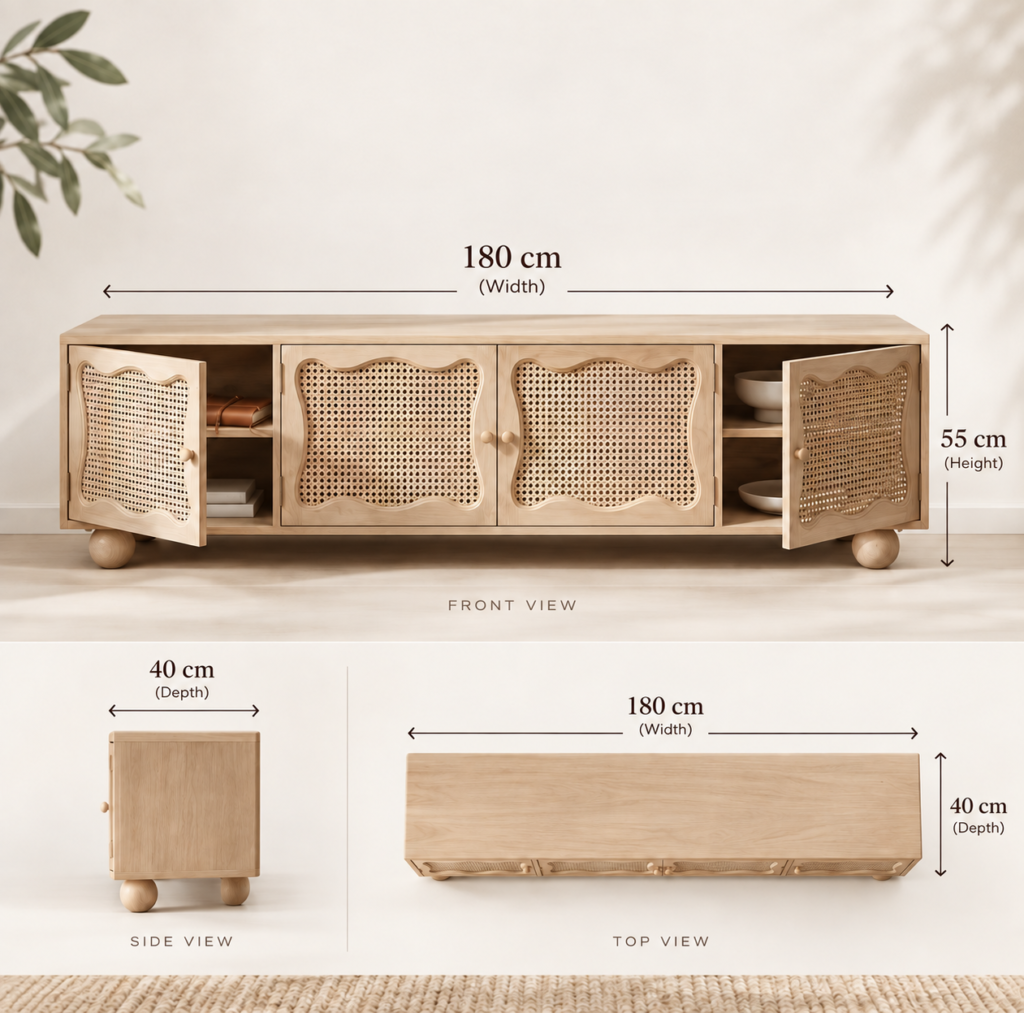
| Ripple TV Unit | 180 × 40 × 55 cm |
| Shale Media TV Unit | 180 × 46 × 55 cm |
| Stirate TV Unit | 140 × 43 × 56 cm |
| Terra Trace TV Unit | 200 × 45 × 56 cm |
Practical Significance of These Dimensions
The collection’s smallest certified design is Stirate (140 × 43 × 56 cm). Because of its shorter length, it is an ideal option for apartments and tiny living rooms where a 180 cm cabinet would take up most of the available wall space. It still has adequate surface area at 43 cm depth for a small soundbar and a typical TV pedestal.
Although they are all 180 cm long, Basal, Ripple, and Shale Media are different in height and depth. The Basal (180 × 40 × 60 cm) is the tallest at 60 cm, making it ideal for spaces with smaller TVs or higher couches that require an additional raise to reach eye level. At 55 cm, the Ripple (180 × 40 × 55 cm) and Shale (180 × 46 × 55 cm) are positioned 5 cm lower, resulting in a more streamlined horizontal line that complements larger screens. Larger media equipment and wide-set TV feet have more surface area thanks to the Shale’s deeper depth (46 cm vs. 40 cm).
The largest unit in the lineup is the Terra Trace (200 × 45 × 56 cm). Its dominating 200 cm length anchors the entire media zone with quiet assurance by providing a solid horizontal base under big screens and across wide living-room walls.
TV Screen Size by TV Unit Size: A Useful Guide
The actual physical width of your television, not only its diagonal screen measurement, should be considered when selecting a TV unit.
A 32-inch TV's TV Unit
A 32-inch screen is approximately 71 cm wide. A compact TV unit generally provides sufficient support without occupying too much wall space. Among the ELVM Homes models with published dimensions, the Stirate TV Unit at 140 cm wide provides generous space around a 32-inch television.
A 43-inch TV Unit
The width of a 43-inch television is roughly 96 cm. A TV unit around 120–140 cm wide can create balanced proportions. The Stirate TV Unit, measuring 140 × 43 × 56 cm, is suitable for this type of setup.
A 55-inch TV Unit
A 55-inch television is around 122 cm wide. A unit between approximately 150 and 180 cm can provide balanced proportions. The Basal TV Unit at 180 × 40 × 60 cm, Ripple TV Unit at 180 × 40 × 55 cm, and Shale Media TV Unit at 180 × 46 × 55 cm all provide a 180 cm-wide surface.
A 65-inch TV Unit
A 65-inch screen is roughly 145 cm wide. TV units in the 180–200 cm width range can provide a broad visual base. The Basal, Ripple, and Shale Media are each 180 cm wide, while the Terra Trace measures 200 × 45 × 56 cm.
A 75-inch TV Unit
A 75-inch television is approximately 168 cm wide. The Terra Trace TV Unit, measuring 200 × 45 × 56 cm, provides the widest surface among the ELVM Homes TV units with currently published dimensions.
TV Unit Height for Various Types of Rooms
When planning the complete seating area, consider how the TV unit works with your sofa and coffee table.
Compact Living Space
A lower-profile TV unit can help prevent a small media wall from feeling visually heavy. The Ripple TV Unit is 55 cm high, the Shale Media TV Unit is 55 cm high, and the Stirate TV Unit is 56 cm high.
Medium Living Room
For medium-sized living rooms, TV units in the mid-height range can work well with many sofa and television arrangements. The Ripple measures 55 cm high, Shale Media 55 cm, Stirate 56 cm, and Basal 60 cm.
Large Living Area
Larger rooms can accommodate wider TV units comfortably. The Basal TV Unit measures 180 × 40 × 60 cm, while the Terra Trace TV Unit measures 200 × 45 × 56 cm and creates a broader horizontal base.
Side tables can help complete the seating arrangement while keeping frequently used items close to the sofa.
Bedroom
TV placement in a bedroom depends heavily on bed height and viewing position. Among the ELVM Homes models with published dimensions, heights range from 55 cm for Ripple and Shale Media to 60 cm for Basal.
How Much Storage Is Actually Needed in a Modern TV Unit Design?
Your daily organising issues should be resolved by a TV unit design with storage without making the furniture appear bulky.
Make a thorough inventory of everything the cabinet must include before making a purchase:
Gaming controllers and remote controls
Set-top boxes and streaming devices
Wi-Fi charges and routers
Books and additional accessories
Power strips, cables, and adapters
Clutter that you would prefer not to see is hidden by closed cabinets. Electronics that require ventilation, frequent access, or an unhindered distant signal are best suited for open compartments. It is usually always more sensible to combine the two rather than stick to just one.
Important Takeaway: Better design does not always equate to more storage. Instead of packing the wall with cabinets you will never use, make compartment selections based on what you actually own.
Selecting the Interior Layout of a TV Unit
The TV unit’s outer silhouette is important, but so is its interior. If your equipment doesn’t fit inside a gorgeously designed cabinet, it can be annoying to live with.
Check these useful details before making a purchase:
Device width: Will the compartment opening accommodate your router, console, or set-top box?
Device depth: Is there sufficient space for cables and plugs behind the device?
Ventilation: Heat is produced by electronics. Long viewing periods may result in overheating in fully enclosed compartments.
Cable access: To get power and HDMI cables to the back of the TV, choose a sensible, clear path.
Shelf height: Compared to books or remote controls, tall gadgets like game consoles may require more vertical clearance.
Your living space will appear deliberate rather than haphazard with a well-thought-out interior design.
Materials That Determine the Character of a TV Unit
Mango Wood
Synthetic materials cannot match the natural warmth, organic texture, and apparent grain of mango wood. Mango wood is used in the Basal, Ripple, Stirate, and Terra Trace pieces of the ELVM collection; solid mango wood is used in the Amber.
Even in India’s humid environment, mango wood is a dense hardwood that doesn’t warp or crack. Because it is gathered from trees that are no longer producing fruit, it is an environmentally responsible option and naturally more resistant to termites than synthetic wood. Mango wood TV cabinets can endure up to 15–20 years if they are properly maintained.
Morchana Marble + Mango Wood
The Shale Media TV Unit creates a captivating conversation between cool, polished stone and warm organic grain by combining mango wood with real Morchana Marble. In interior spaces where the TV unit is supposed to be architectural and statement-led rather than just functional, this mixed-material approach works incredibly well.
Typical Errors in TV Unit Dimensions and Height Selection
Purchasing just based on the diagonal screen size of the television
The “55-inch” label only indicates the diagonal of the screen. It doesn’t show the stand’s true height, footprint, or outside width. Prior to comparing the measurements of TV cabinets, first measure the actual television.
Disregarding TV Unit Height Completely
When the screen and stand are taken into account, a gorgeous cabinet may put your television at an uncomfortable height. Before making a purchase, check your eye level while seated.
Selecting an Overly Narrow Unit
In addition to seeming visually unbalanced, a huge television mounted on a substantially narrower cabinet would not be able to securely support wide-set TV feet.
TV Unit Depth Forgotten
Most purchasing selections are influenced by width, but inadequate depth might make it difficult for the media equipment, soundbar, or television base to fit correctly on the surface.
Disregarding Devices and Cables
Determine the precise locations of the router, streaming box, soundbar, game console, and power connections before placing your purchase.
Selecting More Storage Than You Require
Visual weight increases with the number of cabinets. Instead of packing the wall with furniture you will never use, base your storage decisions on what you actually own.
How to Maintain Your Wooden Television
Wooden TV furniture is kept looking as luxurious and welcoming as the day it was delivered with regular, careful maintenance:
For regular dusting and cleaning, use a soft, dry, or slightly moist microfibre cloth.
Spills should always be cleaned up right once to prevent moisture from remaining on the wood surface.
Steer clear of aggressive chemical cleaners, scouring powders, and abrasive pads that remove the natural finish.
Keep the unit out of direct sunlight for extended periods of time because chronic UV exposure might eventually change the colour of the wood.
Instead of using a one-size-fits-all spray for designs that incorporate wood and marble, such as the Shale Media TV Unit, use cleaning chemicals that are appropriate for each material separately.
To maintain the genuine texture and grain of our hardwood furniture, ELVM’s own care guidelines continuously advise using chemical-free solutions and mild cleaning techniques. ELVM Residences
Choose the Ideal TV Unit Size and Height at ELVM Homes
Measurements should come first. Verify your seated eye level, determine the actual width and height of your television, measure the available wall space, and then compare those numbers with the exact TV unit dimensions.
You can also coordinate the TV unit with console tables used elsewhere in the living room.
The current ELVM Homes TV unit measurements are:
| TV Unit | Dimensions |
|---|---|
| Amber TV Unit | Dimension currently not mentioned on the website |
| Stirate TV Unit | 140 × 43 × 56 cm |
| Ripple TV Unit | 180 × 40 × 55 cm |
| Basal TV Unit | 180 × 40 × 60 cm |
| Shale Media TV Unit | 180 × 46 × 55 cm |
| Terra Trace TV Unit | 200 × 45 × 56 cm |
Frequently asked questions
1. What is the typical height of a TV unit?
A low TV console is usually 16 to 24 inches (1.3 to 2 ft) high. Taller entertainment units with open shelves and closed cabinets can reach 5 to 6 ft.
2. How high should the TV be above the ground?
The centre of the screen should sit at your seated eye level, about 40 to 45 inches (3.3 to 3.7 ft) from the floor. That usually puts the bottom edge of the TV 24 to 30 inches above the floor. The same rule applies to wall-mounted TVs.
3. What are the dimensions of a typical TV unit?
Most units are 48 to 72 inches (4 to 6 ft) long and 14 to 20 inches deep. A console is 16 to 24 inches high, and a full unit can go up to 72 inches. Larger living rooms can take units 7 to 8 ft long.
4. What is a TV unit's typical size in feet?
Most TV units are 4 to 6 ft long, 1.2 to 1.7 ft deep and 1.3 to 2 ft high. Wall-style entertainment units are bigger, around 6 to 8 ft wide and 5 to 7 ft tall.
5. What is the ideal depth for a TV unit?
For most homes, 16 to 18 inches works well. It fits a TV stand base, a set-top box and a soundbar. If you want deeper storage, or you have a gaming console and audio equipment, go for 18 to 20 inches. A wall-mounted TV can go with a slimmer unit of 12 to 14 inches.
6. Is it appropriate for a TV unit to be broader than the TV?
Yes. A unit that extends 6 to 12 inches past the TV on each side looks balanced and keeps the TV stable. A unit narrower than the TV looks top-heavy and can be unsafe.
7. For a 55-inch TV, what TV unit size is appropriate?
A 55-inch TV is about 48.5 inches wide. Pick a unit that is at least 55 to 72 inches (4.5 to 6 ft) long and 16 to 18 inches deep. A 60-inch unit is the most common choice.
8. For a 65-inch TV, what TV unit size is appropriate?
A 65-inch TV is about 57 inches wide. Choose a unit that is 65 to 80 inches (5.5 to 6.5 ft) long and 16 to 20 inches deep. That leaves room around the screen and space for a soundbar.
9. What distinguishes a TV stand, TV cabinet and TV unit?
A TV stand is a low table or frame that the TV sits on, with little or no storage. A TV cabinet is a closed storage piece with doors or drawers, and some designs can hide the TV itself. A TV unit is the broader term for a complete entertainment setup, which can combine a console, open shelves, closed storage, a back panel and wall-mounted elements. In India, "TV unit" is the usual name for modern designs.
10. Is it better to design a TV unit with storage?
In most homes, yes. Storage keeps remotes, set-top boxes, gaming consoles and cables out of sight. Closed cabinets hide what you don't want to see, open shelves suit décor, plants and speakers, and cable management holes at the back keep wiring tidy. In a small room, a slim wall-mounted unit with little storage keeps the space open.
11. What kind of material works best for a TV unit in India?
Humidity, heat and termites are the main concerns. Solid wood such as sheesham, mango or teak is durable and termite resistant, but it costs more. Engineered wood (MDF or HDF with laminate or veneer) is cheaper and comes in many finishes, so it suits modern designs. In humid areas, choose a moisture-resistant grade. Plywood is strong and handles moisture well, which makes it a good fit for coastal regions. Avoid low-grade particle board, because it can swell and weaken in damp conditions. Whichever material you pick, leave ventilation gaps for the heat from the TV and set-top box.
12. How do I select the dimensions of a modern TV unit?
- Measure the width of the TV itself, not just the screen size in inches.
- Add 6 to 12 inches on each side to get the minimum unit length.
- Measure the wall and leave at least 6 to 12 inches free on the sides so the room doesn't feel crowded.
- Set the height so the centre of the screen lands at seated eye level, about 40 to 45 inches from the floor.
- Check the depth against your equipment. 16 to 18 inches is usually enough.
- Match the length to the room: 4 to 5 ft for small rooms, 5 to 6 ft for medium rooms and 6 to 8 ft for large halls.
- Plan storage for your set-top box, console, speakers and cables.