
Dining Table Height and Dimensions: Complete Size Guide
Choosing the right dining table height is important for comfortable meals, proper seating, and a well-planned dining space. A table that is too high or too low can make everyday dining uncomfortable, even when its design looks perfect for your home.
The standard dining table height is 28–30 inches (approximately 71–76 cm or 2.33–2.5 feet), measured from the floor to the top of the table. This height generally works well with dining chairs that have a seat height of 17–19 inches.
However, the right dining table dimensions also depend on your seating requirements, available space, and the design of the table.
This guide explains standard dining table measurements in inches, centimetres, millimetres, and feet, along with chair dimensions, seating capacities, and practical tips for Indian homes.
What Is the Standard Dining Table Height?
The standard dining table height is typically 28 to 30 inches (71–76 cm) from the floor to the tabletop surface. Many modern dining tables measure approximately 75–76 cm in height, making them suitable for everyday family dining.
This standard table height works with most regular dining chairs and allows people to sit comfortably while eating, working, or spending time together.
The typical dining table height remains relatively consistent across different seating capacities. A 4-seater, 6-seater, or 8-seater dining table may have different lengths and widths, but the tabletop height is usually similar.
What Is the Ideal Tabletop Height for Everyday Dining?
For most households, a table top height of approximately 75–76 cm (29.5–30 inches) is a practical choice.
This height generally provides a comfortable eating surface when paired with appropriately sized dining chairs. It is also suitable for dining spaces that occasionally serve as places for reading, working, or children’s activities.
However, the ideal height depends on the people using the table and the available legroom beneath it.
Is 30 Inches the Standard Dining Table Height?
Yes. A 30-inch dining table is a common standard-height option.
It measures 76.2 cm or 762 mm from the floor to the tabletop. A slightly lower table measuring 28 or 29 inches can also fall within the normal dining table height range.
Rather than focusing on one exact measurement, check whether the table and chairs work comfortably together.
Dining Table Height in Inches, CM, MM and Feet
Dining table measurements are often listed in different units depending on the furniture manufacturer. Understanding these measurements makes it easier to compare products and choose the correct size.
The following chart shows the typical dining table height in inches, centimetres, millimetres, and feet. For accurate conversions, the NIST unit conversion guide confirms that 1 inch equals 2.54 centimetres.
Height in Inches | Height in CM | Height in MM | Height in Feet |
28 inches | 71.1 cm | 711 mm | 2.33 ft |
29 inches | 73.7 cm | 737 mm | 2.42 ft |
30 inches | 76.2 cm | 762 mm | 2.50 ft |
Standard Dining Table Height in Feet
The typical dining table height in feet ranges from approximately 2.33 to 2.5 feet.
A 30-inch dining table is exactly 2 feet 6 inches tall, making it one of the most common heights for residential dining furniture.
Standard Dining Table Height in CM and MM
In centimetres, the usual dining table height is approximately 71–76 cm.
In millimetres, this equals roughly 711–762 mm.
Many dining tables designed for modern Indian homes have a height close to 75 or 76 cm.
When checking product specifications, always confirm that the listed height is measured from the finished floor to the upper surface of the tabletop.
Standard vs Counter vs Bar Height Dining Tables
Not every dining table has the same height. Standard dining tables, counter-height tables, and bar-height tables are designed for different seating arrangements and purposes.
Understanding these differences is especially important when choosing furniture for open kitchens, breakfast corners, or dining areas.
Table Type | Height in Inches | Height in CM | Suitable Seating |
Standard Dining Table | 28–30 | 71–76 | Regular dining chairs |
Counter-Height Table | 34–36 | 86–91 | Counter stools |
Bar-Height Table | 40–42 | 102–107 | Bar stools |
Standard Dining Table Height
Standard-height dining tables are commonly used in residential dining rooms.
Their lower seating position makes them practical for everyday meals, family gatherings, and extended dining sessions.
They are also available in rectangular, round, square, and oval designs.
Counter and Breakfast Table Height
A counter-height dining table generally measures 34–36 inches (86–91 cm).
This height is suitable for casual dining arrangements, especially when the table is positioned near a kitchen counter or island.
The breakfast table height depends on the design. A conventional breakfast table may measure 28–30 inches, while a breakfast counter typically follows the higher 34–36-inch range.
Counter-height tables require taller seating than regular dining chairs.
Bar Height Table
A high table designed for bar-style dining usually measures around 40–42 inches (102–107 cm).
These tables work well in entertainment areas, breakfast bars, and casual seating spaces.
However, they are not interchangeable with standard dining tables. They require appropriately sized bar stools and may be less convenient for young children or people who prefer conventional seating.
For everyday family dining, a standard-height table is generally the more versatile option.
What Is the Standard Dining Table Chair Height?
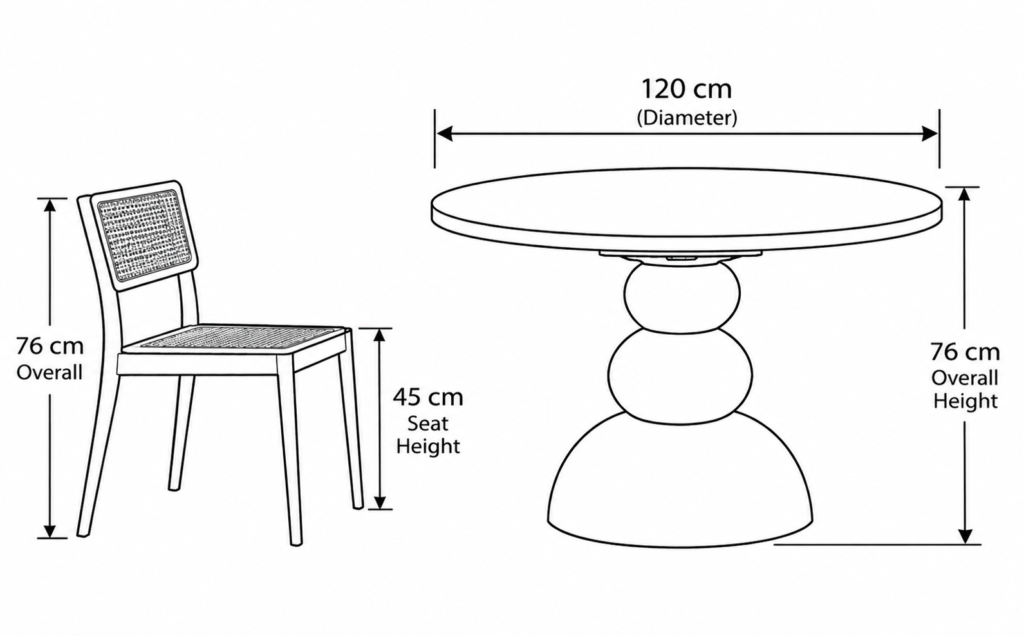
The standard dining table chair height is approximately 17–19 inches (43–48 cm), measured from the floor to the seating surface.
A chair with a seat height of around 45–46 cm is a common pairing for a dining table measuring approximately 75–76 cm.
However, dining chair height should not be confused with the total height of the chair, which includes the backrest.
The typical dining table height remains relatively consistent across different seating capacities. A 4-seater, 6-seater, or 8-seater dining table may have different lengths and widths, but the tabletop height is usually similar.
Standard Dining Table Chair Dimensions
The following measurements provide a general reference for choosing dining chairs.
Chair Measurement | Typical Size in CM |
Seat Height | 43–48 cm |
Seat Width | 43–51 cm |
Seat Depth | 41–51 cm |
Overall Chair Height | 76–91 cm |
Ideal Gap Between Dining Chair and Tabletop
A comfortable dining arrangement generally allows around 25–30 cm (10–12 inches) between the chair seat and the tabletop surface. For more guidance on seat height, chair width and tabletop clearance, see The Spruce’s dining chair sizing guide.
For example, a 76 cm dining table paired with a 46 cm chair seat creates a 30 cm difference.
However, the space available for your thighs and knees may be smaller because the tabletop thickness and supporting frame occupy some of this gap.
How to Check Knee and Leg Clearance
Before selecting a dining table and chairs, check the space beneath the tabletop.
A table with a thick apron or supporting frame may provide less knee clearance than a table with a slim tabletop, even when both have the same overall height.
Also, make sure chairs with armrests can slide beneath the tabletop without hitting its underside.
Comfortable dining depends on the complete table-and-chair arrangement, not simply the height of each piece.
How to Measure Dining Table Height Correctly
Accurate dining table measurements are important when buying furniture online or selecting chairs for an existing table.
Measure from Floor to the Top of the Table
Place one end of a measuring tape on the floor next to the dining table.
Extend the tape vertically to the upper surface of the tabletop. This gives you the complete table height.
For example, if the measurement is 76 cm, the table is approximately 30 inches high.
Ensure that you measure from the finished floor surface rather than from the bottom of the table legs or the supporting frame.
Check Tabletop Thickness and Under-Table Clearance
Next, measure the distance from the floor to the underside of the table.
This measurement helps determine the available knee and leg clearance.
If your dining chairs have armrests, compare their armrest height with the underside of the table.
Also, consider any central pedestal or decorative base that might reduce foot or leg space.
These additional measurements are particularly useful when purchasing dining chairs separately from the table.
Standard Dining Table Dimensions for 4, 6 and 8 Seaters
While dining table height usually remains consistent, the length and width change according to seating capacity.
The following standard dining table dimensions offer a practical starting point for choosing furniture for different household sizes.
Seating Capacity | Typical Length | Typical Width | Typical Height |
4-Seater | 120–135 cm | 75–90 cm | 71–76 cm |
6-Seater | 150–180 cm | 85–100 cm | 71–76 cm |
8-Seater | 200–240 cm | 90–110 cm | 71–76 cm |
These are indicative dimensions for rectangular tables. Actual seating capacity depends on chair width, leg placement, tabletop shape, and available elbow room. For additional seating and table-shape examples, see Room & Board’s dining table size guide.
4-Seater Dining Table Dimensions
A typical 4-chair dining table size is approximately 120 × 75 cm, although larger rectangular designs may measure 135 × 90 cm.
This size can work well for smaller families, compact dining areas, and apartments.
A square dining table measuring around 90 × 90 cm is another option for four people.
Round tables can also accommodate four diners, depending on their diameter and base design.
6-Seater Dining Table Dimensions
A standard rectangular 6-seater dining table generally measures 150–180 cm in length and approximately 85–100 cm in width.
A longer tabletop offers additional elbow room and space for serving dishes during family meals.
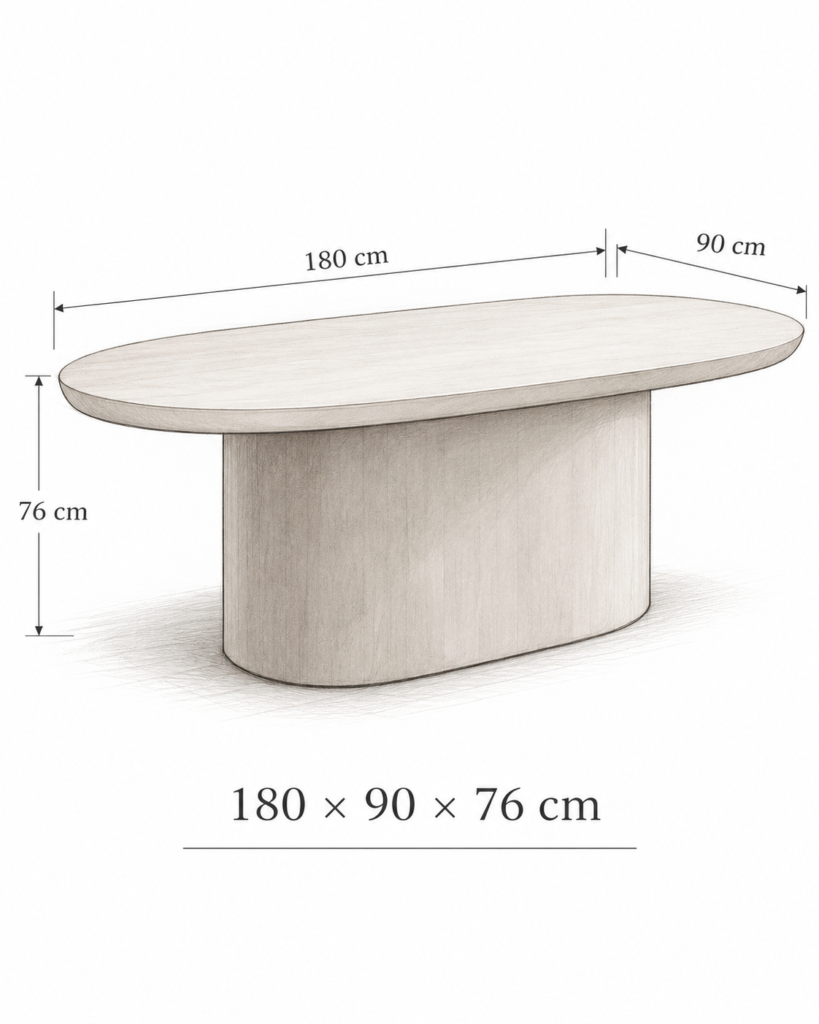
Six-seater dining tables are suitable for households that need everyday seating along with some flexibility for guests. For example, the Nimbus Dining Table measures 180 × 90 × 76 cm; check the table base and intended chair widths when planning seating.
8-Seater Dining Table Dimensions
An 8-seater dining table commonly measures around 200–240 cm in length and 90–110 cm in width.
These dimensions are suitable for larger dining areas where chairs can be arranged comfortably along the sides and ends.
Before selecting a large dining table, measure the entire room rather than focusing only on the table length.
Does Dining Table Shape Affect Its Dimensions?
Yes. Table shape has a significant effect on length, width, and seating arrangements.
Rectangular tables suit longer rooms and larger families. Round tables encourage conversation and can work well in square-shaped spaces, while oval tables combine an elongated dining surface with curved edges.
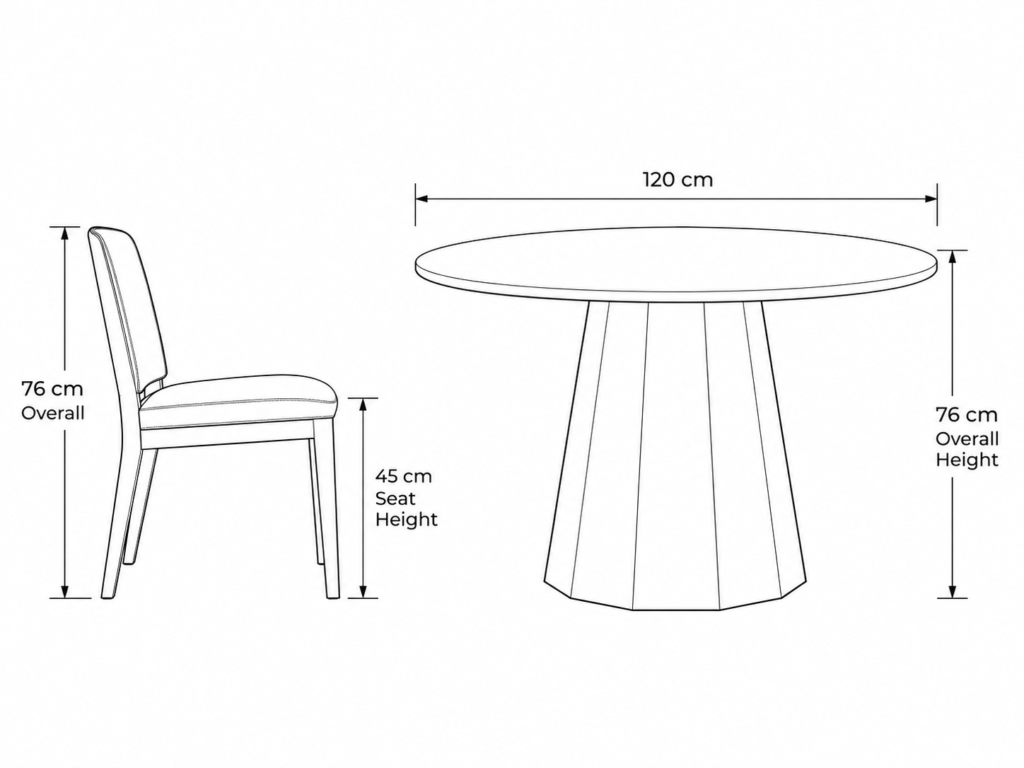
For round dining tables, the main measurement is diameter rather than length and width.
A round table measuring approximately 100–120 cm in diameter can accommodate four people, depending on chair dimensions and pedestal clearance.
Regardless of shape, standard dining tables generally remain within a similar height range.
How Much Space Should You Leave Around a Dining Table?
Choosing the correct dining table dimensions involves more than measuring the tabletop.
You also need enough room to pull out chairs, sit comfortably, and move around the dining area.
As a practical starting point, allow approximately 90 cm (36 inches) between the table edge and a nearby wall or furniture piece where chairs need to be used.
For areas where people frequently walk behind occupied chairs, additional clearance of around 110–120 cm or more may be preferable. For another room-planning reference, IKEA’s dining furniture guide suggests at least 80 cm near a wall and more room alongside kitchen cabinetry.
Chair Pull-Out and Walking Space
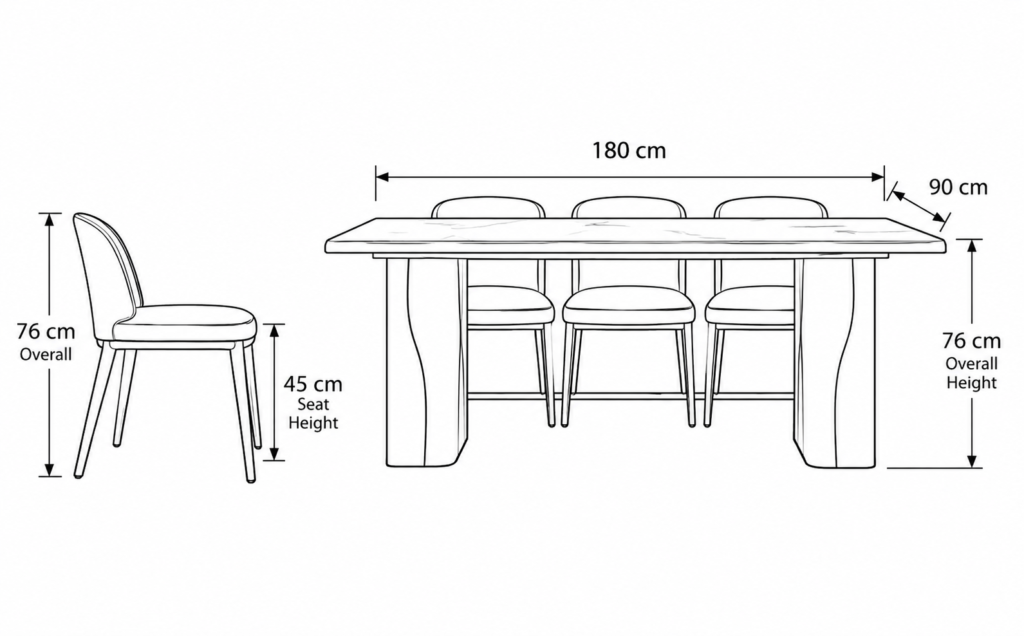
For example, consider a dining table measuring 180 × 90 cm.
With 90 cm of clearance on every side, the overall space required becomes approximately:
- Length: 180 + 90 + 90 = 360 cm
- Width: 90 + 90 + 90 = 270 cm
This means the arrangement requires an unobstructed area of approximately 3.6 × 2.7 metres for the table and surrounding chair space.
Wider circulation routes may be necessary depending on the room layout and chair design.
Choosing a Table for a Small Dining Area
In compact dining spaces, choose a table with proportions that leave adequate room for circulation.
A round or compact rectangular table may work well, depending on the position of walls, doors, and surrounding furniture.
Consider slim dining chairs and avoid oversized armchairs when space is limited.
For pedestal dining tables, check the position and width of the base to ensure diners have enough room for their feet.
The best dining table size is one that supports comfortable daily use without making the room feel crowded.
How to Choose the Right Dining Table Height for Your Home
The ideal dining table height should suit your seating preferences, daily activities, and available space.
Consider the Height of Family Members
Most adults can use a standard-height dining table comfortably, but individual preferences vary.
For households with children, shorter adults, or people with mobility requirements, consider the actual seated position and ease of getting in and out of the chair.
Match the Dining Chairs with the Table
Always compare the chair seat height with the table’s overall height and underside clearance.
For a dining table measuring 75–76 cm, chairs with a seat height of approximately 43–48 cm are a useful starting point.
Test the seating arrangement where possible, especially if the chairs have thick cushions, wide armrests, or unusual proportions.
Choose a Height for Everyday Dining or Breakfast
A standard-height dining table is generally suitable for regular family meals.
If your dining area is integrated with a kitchen island or breakfast counter, a counter-height table may be more appropriate.
Also, consider how frequently the furniture will be used and whether you prefer relaxed conventional seating or elevated counter-style seating.
The most suitable height is the one that offers comfortable posture, sufficient legroom, and convenient everyday use.
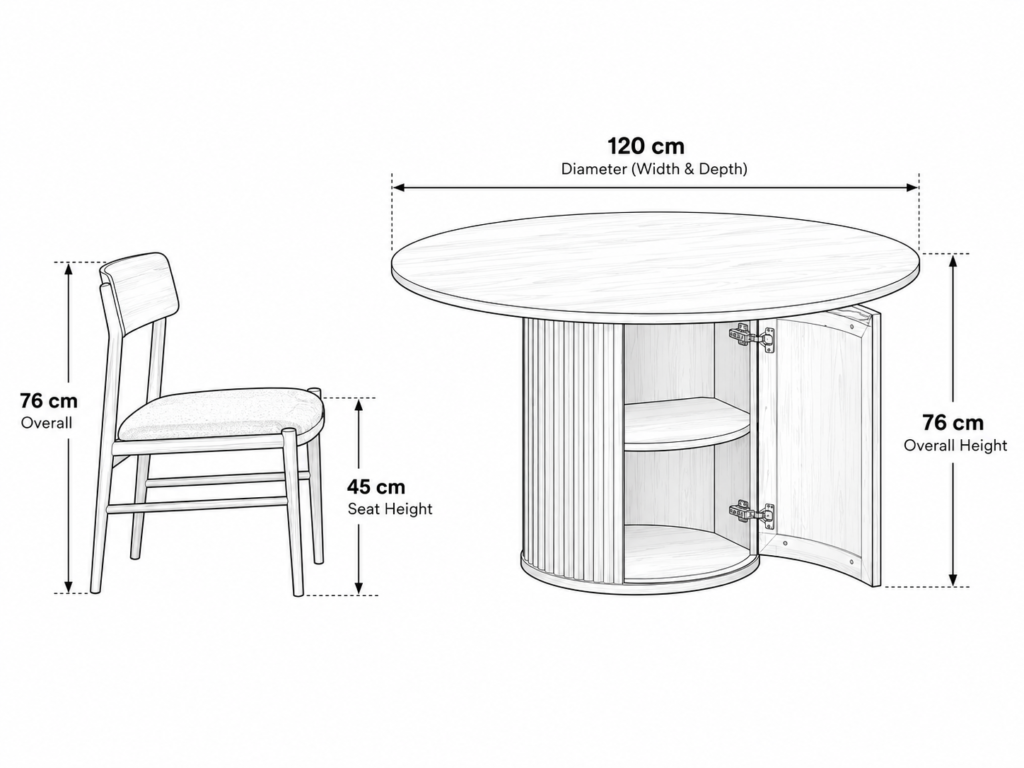
Dining Table Height Examples from ELVM Homes
Understanding standard measurements becomes easier when comparing them with actual furniture designs.
At ELVM Homes, dining tables are available in different shapes, materials, and dimensions for contemporary interiors.
Here are two examples that demonstrate how standard dining table height works across different tabletop shapes.
Tessera Dining Table – 76 cm Height
The Tessera Dining Table measures 180 × 90 × 76 cm (L × W × H).
Crafted from mango wood, this dining table features an elongated, pill-shaped silhouette with rounded ends and a smoked mocha finish.
Its 76 cm height falls within the standard dining table height range, while the 180 cm length provides an extended surface for dining arrangements.
The rounded tabletop design also offers an alternative to conventional rectangular tables.
Before pairing it with chairs, check the available legroom and the dimensions of the selected seating.
Frequently Asked Questions About Dining Table Height
1. What is the standard dining table height in India?
The standard dining table height in India is generally 28–30 inches (approximately 71–76 cm). Many modern dining tables measure around 75–76 cm, making them suitable for regular dining chairs and everyday family use.
2. How tall is a dining table in feet?
The typical dining table height in feet is approximately 2.33–2.5 feet. A 30-inch dining table measures exactly 2.5 feet, or 2 feet 6 inches, from the floor to the tabletop surface.
3. Is 30 inches a good dining table height?
Yes. A 30-inch dining table is a common standard-height choice for residential dining rooms. It generally works well with dining chairs measuring approximately 17–19 inches in seat height, provided there is adequate knee clearance.
4. What chair height is suitable for a 76 cm dining table?
A dining chair with a seat height of approximately 43–48 cm is generally suitable for a 76 cm dining table. Around 45–46 cm is a common pairing, but the final choice should account for seat cushioning, tabletop thickness, and under-table clearance.
5. Is dining table height the same for 4, 6 and 8 seaters?
Yes. Standard 4-seater, 6-seater, and 8-seater dining tables commonly have similar heights of approximately 71–76 cm. Their main differences are usually the length, width, shape, and amount of seating space available.
Conclusion: Choosing the Right Dining Table Height
The right dining table height makes everyday meals more comfortable and helps create a balanced dining arrangement.
For most homes, a standard dining table height of 28–30 inches (71–76 cm) is a practical choice. However, chair height, tabletop thickness, legroom, seating capacity, and surrounding floor space are equally important.
Before purchasing a table, compare its actual measurements with your available dining area and existing chairs.
Explore the modern dining tables at ELVM Homes to find different shapes, materials, and dimensions suited to your space.