
Coffee Table Height Guide with Standard Sizes and Dimensions
A coffee table is more than a decorative piece in the middle of your living room. It is where you place your morning coffee, serve snacks to guests, keep your favourite books, and reach for everyday essentials. However, even a carefully designed coffee table can feel uncomfortable if its height does not match your seating arrangement.
Choosing the right coffee table height makes a difference to both comfort and appearance. A table that is too low may require constant bending, while one that is too high can interrupt the visual balance of your sofa and surrounding furniture.
Many homeowners focus on materials, colours, and designs while overlooking measurements. Understanding coffee table height, width, length, and placement can help you avoid choosing furniture that looks attractive but does not function well in your space.
Whether you are furnishing a compact apartment, updating a modern living room, or selecting furniture for a larger home, this guide explains standard coffee table measurements in centimetres and inches. You will also learn how to choose the right center table size for different sofas, room layouts, and everyday needs.
What Is the Standard Coffee Table Height?
The standard coffee table height is generally 16 to 18 inches (approximately 41 to 46 cm). This measurement works with many conventional sofas because it allows the tabletop to remain close to the seating level.
However, there is no single height that works for every living room. Modern sofas come in different designs, from low-profile lounge seating to taller, more structured upholstered furniture.
A low sofa may look better with a shorter coffee table, while a sofa with a higher seat may require a slightly taller design.
The purpose of standard measurements is to provide a starting point rather than a fixed rule.
Standard Coffee Table Height in CM and Inches
Coffee Table Type | Height in CM | Approximate Height in Inches |
Low coffee table | 30–38 cm | 12–15 inches |
Standard coffee table | 41–46 cm | 16–18 inches |
Tall coffee table | 47–51 cm | 18.5–20 inches |
These height ranges are general furniture-planning guidelines.
When selecting a table, compare its finished height with your sofa seat rather than choosing a size based only on the category it belongs to.
For example, a 42 cm coffee table may work comfortably beside a 45 cm sofa seat. However, the same table might feel relatively tall in front of a very low lounge sofa.
The ideal height is the measurement that allows the furniture to look balanced and remain convenient to use.
How High Should a Coffee Table Be Compared to a Sofa?
One of the simplest ways to determine the ideal coffee table height is to measure your sofa.
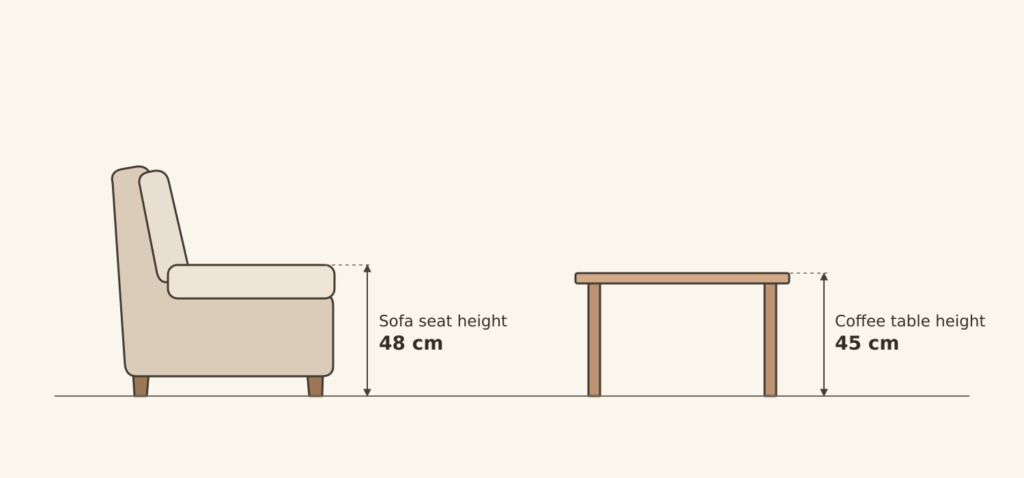
As a general rule, the tabletop should be approximately level with the sofa seat or 2.5 to 5 cm (1 to 2 inches) lower.
This difference keeps everyday essentials within reach and helps maintain a natural visual connection between the two pieces of furniture.
For example, if your sofa seat measures 46 cm from the floor, a coffee table measuring approximately 41 to 46 cm high would be a reasonable starting point.
A table that is significantly taller than the sofa can make the seating area feel crowded. Conversely, a very short table may force you to bend forward whenever you need something.
Coffee Table Height Based on Sofa Seat Height
Sofa Seat Height | Recommended Coffee Table Height |
38 cm | 33–38 cm |
40 cm | 35–40 cm |
42 cm | 37–42 cm |
45 cm | 40–45 cm |
48 cm | 43–48 cm |
50 cm | 45–50 cm |
These recommendations are flexible. Personal comfort, furniture design, and the way you use your coffee table can influence the final choice.
For a sofa with deep, soft cushions, consider how much the seat compresses when someone sits down. A sofa may measure 47 cm when empty but feel noticeably lower during use.
Measuring the seated height can therefore provide a more realistic reference.
Should a Coffee Table Be Higher or Lower Than a Sofa?
In most living rooms, a coffee table that sits at the same height as the sofa seat or slightly below it creates a comfortable arrangement.
A lower tabletop often complements contemporary seating with broad cushions and relaxed proportions. It can also make the room appear visually open because the central furniture remains closer to the floor.
A table at seat height offers convenient access to drinks, books, and other everyday items.
Although a slightly taller coffee table is possible, the additional height should serve a practical purpose.
If you frequently use the surface for meals or laptop work, a higher table may seem appealing. However, a standard fixed-height coffee table is not necessarily a comfortable replacement for a dining table or desk.
Instead of selecting a significantly taller design, consider the activity, your seating posture, and whether a separate working surface would be more suitable.
What Is the Center Table Standard Size?
A commonly useful center table standard size for a living room is approximately 90–120 cm in length, 45–60 cm in width, and 40–46 cm in height.
These measurements are practical examples for rectangular tables, not universal industry requirements.
In India, the terms coffee table and center table are frequently used interchangeably. Both generally describe a table positioned near the primary seating area.
However, the ideal dimensions vary according to sofa length, room size, table shape, and the space available for movement.
Standard Center Table Size Chart
Living Room Size | Suggested Length | Suggested Width | Suggested Height |
Small living room | 60–90 cm | 40–50 cm | 38–45 cm |
Medium living room | 90–120 cm | 45–60 cm | 40–46 cm |
Large living room | 120–140 cm | 60–70 cm | 40–48 cm |
The height ranges shown here are starting points, not requirements based on room size. Always compare the height with your sofa.
A large table can look impressive in a spacious room but feel overwhelming in a compact apartment. Similarly, a very small table may appear disconnected from a long sofa.
Choosing balanced proportions is more important than selecting the largest available design.
Understanding Center Table Dimensions
Before purchasing a coffee table, it is important to understand the three measurements commonly listed in furniture specifications.
These are length, width, and height.
1. Coffee Table Length
Length refers to the longest horizontal measurement of the table.
It influences how much usable surface area is available and how the table relates visually to the sofa.
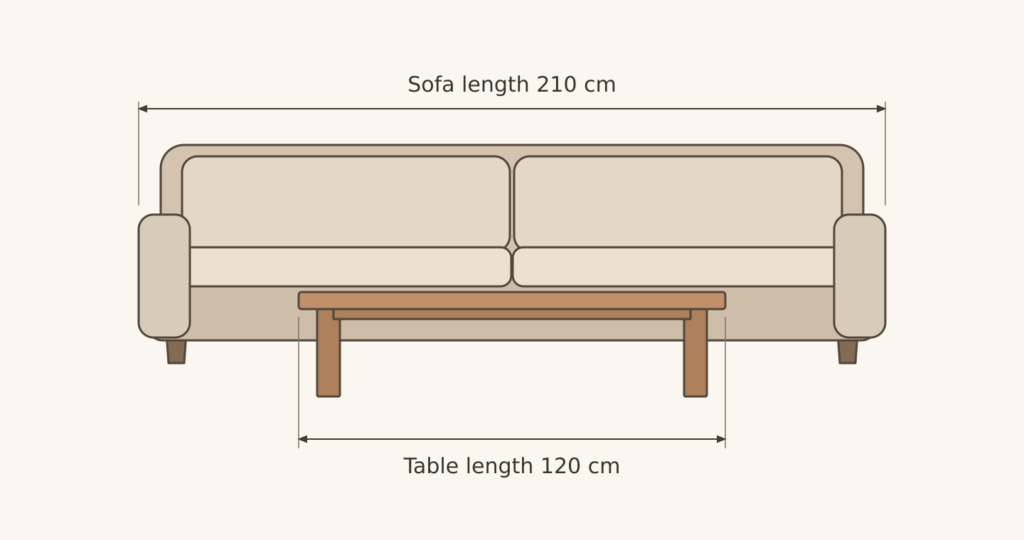
A useful starting guideline is to choose a coffee table around one-half to two-thirds of your sofa’s length.
For example, if your sofa measures 210 cm long, a coffee table approximately 105–140 cm long may create a balanced arrangement.
The appropriate size also depends on whether you have side tables, armchairs, or additional seating around the sofa.
2. Coffee Table Width
Width measures the distance from the front to the back of the tabletop.
A wider table provides additional space for books, drinks, and decorative accessories. However, it also occupies more floor area.
If your living room is narrow, a slim rectangular or oval table may work better than a broad square design.
Always consider the space between the coffee table and surrounding furniture.
3. Coffee Table Height
Height is measured vertically from the floor to the top of the finished tabletop.
Of all the center table dimensions, height has a particularly important influence on seated comfort.
It affects how naturally you can reach for items and how well the coffee table aligns with the sofa.
When comparing different tables, examine all three dimensions together rather than focusing on only one measurement.
How Coffee Table Height Changes the Look of Your Living Room
Coffee table height influences more than functionality. It also changes the visual proportions of the seating area.
A low coffee table can make a room feel relaxed and contemporary, especially when paired with a low sofa and minimal furniture.
A standard-height table can create a balanced appearance in traditional and modern living rooms.
A taller table may suit seating with raised cushions or a more upright design.
Low Coffee Tables Between 30 and 38 CM
Low-height tables are popular in interiors that emphasise clean lines and relaxed seating.
Their reduced height can help preserve sightlines across the room. They may also complement larger furniture pieces without competing for attention.
However, a low table may be inconvenient if you frequently reach for cups, plates, or books.
Standard Coffee Tables Between 41 and 46 CM
This range is versatile because it suits many conventional sofa heights.
Tables within these measurements provide a practical surface for everyday living room activities without appearing excessively tall.
If you are unsure where to begin, compare a table in this height range with your sofa before exploring other options.
Taller Coffee Tables Between 47 and 51 CM
Taller coffee tables may work well with raised seating or for users who find lower surfaces inconvenient.
However, their proportions need careful consideration.
A taller tabletop beside a short sofa can look visually dominant and may reduce the relaxed character of the seating area.
Choose height according to comfort and proportions rather than assuming that a taller table is always more practical.
How Much Space Should Be Between a Coffee Table and Sofa?
The distance between a coffee table and sofa is just as important as the table’s height.
A useful starting distance is approximately 30–46 cm (12–18 inches) between the front edge of the sofa and the nearest edge of the coffee table.
This provides room for legs while keeping the surface within comfortable reach.
If the table sits too close, standing up and moving around the furniture may become inconvenient.
If it is too far away, reaching for your drink or remote may require leaning forward excessively.
Recommended Living Room Clearance
Location | Suggested Clearance |
Sofa to coffee table | 30–46 cm |
Main walking pathway | 75–90 cm |
Coffee table to nearby furniture | Depends on use and access |
These are planning guidelines rather than strict rules.
In a small apartment, maintaining generous walkways may require selecting a narrower table.
For open-plan living rooms, sufficient clearance around the table helps people move naturally between seating, dining, and other areas.
Always measure the room with the surrounding furniture in place.
Choosing Coffee Table Size for Different Sofa Types
Different sofa arrangements require different coffee table proportions.
Even when two sofas have similar seat heights, their shapes and lengths can influence which table works best.
Coffee Table for a Two-Seater Sofa
A two-seater sofa generally works well with a compact coffee table.
Round, oval, and short rectangular designs can provide enough tabletop space without dominating the seating area.
If your sofa measures approximately 150 cm long, a coffee table around 75–100 cm long may be a useful starting point.
Coffee Table for a Three-Seater Sofa
A three-seater sofa typically needs a slightly longer coffee table to maintain visual balance.
For a sofa measuring 210 cm long, consider a table around 105–140 cm long, depending on the room layout.
Rectangular and oval shapes often work well because their elongated surfaces complement the horizontal proportions of the sofa.
Coffee Table for an L-Shaped Sofa
L-shaped sofas often create a defined open area in the centre of the seating arrangement.
Round, square, or oval coffee tables can work well in this space.
A round table may make it easier to approach the surface from different seating positions, while a rectangular table may suit a longer sectional.
Coffee Table for a Recliner Sofa
Recliner sofas require additional planning because their footrests extend outward.
Before purchasing, extend the recliner fully and measure the space required.
A smaller or easily movable coffee table may be more convenient than a large fixed table in this arrangement.
What Is the Best Center Table Size for a Small Living Room?
Small living rooms benefit from furniture that offers everyday functionality without taking up unnecessary space.
A center table measuring approximately 60–90 cm long can be a practical starting point for compact seating areas.
However, the ideal width and height depend on the sofa and available floor space.
Round tables can soften the appearance of a room filled with rectangular furniture. Narrow oval tables provide useful surface area while reducing the visual impact of sharp corners.
A compact rectangular design can also work well when the sofa faces a television unit.
For additional storage, designs with shelves or compartments can help keep the tabletop organised.
The goal is to create a comfortable living area rather than filling every available corner.
What Coffee Table Height Works Best for Different Activities?
The ideal coffee table height can also depend on how frequently you use the surface and what activities take place around it.
A coffee table used mainly for decoration may have different practical requirements from one regularly used for snacks, reading, or occasional laptop work.
Coffee Table Height for Tea and Snacks
For everyday tea, coffee, and light snacks, a tabletop positioned at or slightly below the sofa seat usually provides convenient access.
For example, a sofa with a 45 cm seat height may work well with a coffee table around 40–45 cm high.
Choose a stable surface that provides enough room for cups, coasters, and serving trays without making the table feel overcrowded.
Coffee Table Height for Eating
Some households occasionally use a coffee table for informal meals while sitting on the sofa.
A table close to seat height may be more convenient than a very low surface, but it does not automatically provide an ergonomic eating position.
For regular meals, a dining table or purpose-designed adjustable table is usually more suitable.
Consider both tabletop height and the distance between your body and the table.
Coffee Table Height for Laptop Work
Occasional laptop use is possible on many coffee tables, but working for extended periods on a low surface may encourage forward bending.
A taller fixed coffee table does not necessarily solve the problem because screen position, seating support, and keyboard height also affect comfort.
If you regularly work from your living room, a dedicated work surface or adjustable laptop table may be a better choice.
Coffee Table Height for Children’s Activities
Children may use a coffee table for drawing, puzzles, or supervised activities.
However, there is no single coffee table height suitable for children of every age.
Choose a stable table with suitable edges, and consider whether a child-sized desk or activity table would be more appropriate for regular use.
Avoid leaving hot drinks, fragile decorations, or small hazardous objects within children’s reach.
What Is the Best Coffee Table Height for Elderly People?
For older adults, comfort, easy access, and safe movement can be more important than following a standard coffee table measurement.
A very low table may require excessive forward bending, particularly for someone who finds bending or standing up difficult.
As a starting point, selecting a coffee table close to the sofa’s occupied seat height can help keep everyday items within easier reach.
However, the ideal measurement depends on the individual’s mobility, arm reach, seating posture, and personal preferences.
Important Considerations for Senior-Friendly Coffee Tables
- Accessible surface height: Choose a tabletop that can be reached comfortably while seated without excessive leaning.
- Stable construction: Avoid unstable or easily tipped furniture that may move unexpectedly.
- Clear walking paths: Leave sufficient space around the table, particularly where mobility aids are used.
- Rounded edges: Softer corners may reduce the severity of accidental contact.
- Convenient placement: Frequently used items should remain accessible without stretching across the entire tabletop.
For someone with knee pain or reduced mobility, the sofa’s own height and support may matter more than increasing the coffee table height.
A coffee table should never be used as a support for standing up unless it has been specifically designed and assessed for that purpose.
The most suitable option is one that allows comfortable reaching without interfering with safe movement around the room.
Does Coffee Table Shape Affect the Ideal Height?
Coffee table shape does not directly determine the ideal height, but it affects how the table looks and functions in the room.
Round Coffee Tables
Round coffee tables work well in seating arrangements where several people need access to the tabletop.
Their curved edges can make movement around the table easier in compact spaces.
Rectangular Coffee Tables
Rectangular tables are particularly suitable for longer sofas.
Their elongated shape offers space for multiple items and follows the proportions of conventional seating arrangements.
Square Coffee Tables
Square coffee tables can create a balanced focal point in symmetrical seating layouts.
They often work well with L-shaped sofas and arrangements featuring multiple chairs around a central surface.
Oval Coffee Tables
Oval tables combine an elongated surface with curved ends.
They can be a useful choice when you want the length of a rectangular table without its angular appearance.
Whatever shape you choose, compare its finished height and full footprint with your actual seating arrangement.
Coffee Table Height for Floor Seating and Diwan Arrangements
Not every Indian living room uses conventional sofas.
Some homes include diwans, floor cushions, or low seating arrangements.
For floor cushions or informal floor seating, a table around 20–30 cm high may be worth considering, depending on the cushion thickness and seated posture.
For a diwan, measure the actual seating surface rather than relying on the overall height of the wooden frame.
A low table can work well for serving tea or displaying decorative items in these arrangements.
However, floor-level seating may not be comfortable or accessible for everyone.
Before selecting a short table, consider how easily users can sit down, stand up, and reach the tabletop.
Which Coffee Table Material Is Best for Indian Weather?
Material selection plays an important role in the long-term appearance and maintenance of coffee tables.
Indian homes can experience different environmental conditions, including summer heat, monsoon humidity, and changes in indoor temperature.
The performance of furniture depends on the material, construction quality, protective finish, and surrounding environment.
Solid Wood Coffee Tables
Solid wood is appreciated for its natural grain, warmth, and distinctive character.
Wood naturally responds to changes in humidity by absorbing or releasing moisture. This can cause slight expansion or contraction.
Proper seasoning, suitable construction, consistent indoor conditions, and an appropriate finish can help reduce unwanted movement.
Solid wood should not be considered automatically waterproof or termite-resistant.
Avoid prolonged exposure to standing water and follow the manufacturer’s recommended care instructions.
Engineered Wood and MDF Coffee Tables
Engineered wood products include different materials, such as plywood, particleboard, and MDF.
Their performance varies considerably according to the board quality, adhesive, protective coating, and edge sealing.
MDF and particleboard can swell when moisture penetrates exposed edges or damaged finishes.
For homes with high humidity, examine the specifications carefully rather than assuming that all engineered materials behave identically.
Marble and Natural Stone Coffee Tables
Marble and natural stone can introduce distinctive colour, texture, and veining into a living room.
However, some natural stones are porous and may absorb liquids. Marble is also sensitive to acidic substances that can affect its finish.
Use coasters, clean spills promptly, and follow the recommended sealing and maintenance instructions for the specific stone.
Comparing Coffee Table Materials
Material | Main Advantage | Important Care Consideration |
Solid wood | Natural grain and character | Responds to humidity changes |
MDF | Smooth, versatile surfaces | Vulnerable to moisture at exposed edges |
Plywood | Layered construction and versatility | Quality and moisture resistance vary |
Marble | Natural pattern and refined appearance | Can stain or etch |
Glass | Visually light appearance | Fingerprints, breakage risk, and cleaning |
No material is universally the best option for every Indian home.
Select a coffee table according to your room conditions, expected use, preferred appearance, and ability to maintain the surface.
How Much Clearance Should a Coffee Table Have Underneath?
Under-table clearance is an often-overlooked measurement when choosing coffee table dimensions.
The available space beneath the furniture can influence how easily you clean the floor and whether a vacuum cleaner or robotic cleaning device can pass under the table.
Clearance for Regular Mopping
A coffee table with open legs may make it easier to access the floor underneath.
Around 10–15 cm of unobstructed space can be helpful for some flat mops, although the actual clearance required depends on the mop head and handle angle.
Tables with wide bases, enclosed storage, or low platforms may need to be moved during cleaning.
Clearance for Robot Vacuum Cleaners
Robot vacuum cleaners vary in height.
Before selecting a coffee table, check the height of your particular cleaning device, including any raised sensor components.
The under-table clearance should exceed the robot’s total height, with a small additional margin recommended by the device manufacturer.
For example, a robot measuring 10 cm high may require more than 10 cm of unobstructed space to move reliably beneath furniture.
How to Measure Under-Table Clearance
Measure vertically from the floor to the lowest fixed part underneath the table.
Do not assume that the total coffee table height represents the available cleaning space.
A coffee table measuring 45 cm high may still have almost no under-table clearance if it features a solid pedestal or closed base.
Checking this detail before purchasing can make everyday cleaning much more convenient.
Real Coffee Table Dimensions from ELVM Homes
Actual product measurements provide useful examples of how different table heights and shapes work in a living room.
The following examples are listed in the ELVM Homes coffee table collection.
Coffee Table | Dimensions (L × W × H) | Height |
Bento Coffee Table | 120 × 60 × 42 cm | 42 cm |
Pebble Coffee Table | 120 × 60 × 45 cm | 45 cm |
Basal Coffee Table | 90 × 90 × 45 cm | 45 cm |
Facet Coffee Table | 80 × 80 × 46 cm | 46 cm |
Orbit Coffee Table | 90 × 90 × 33 cm | 33 cm |
These examples show how tables with similar heights can offer different usable surface areas.
A rectangular 120 cm table may complement a longer sofa, while a round design measuring 80 or 90 cm across may work better in a centralised seating arrangement.
The 33 cm example also demonstrates how a low-profile coffee table differs from conventional heights.
Explore the coffee table collection at ELVM Homes to compare contemporary wooden, marble, round, rectangular, and sculptural designs.
How to Measure Coffee Table Height Before Buying
Measuring correctly can prevent many furniture-buying mistakes.
Follow these steps before selecting a coffee table.
Step 1. Measure Your Sofa Seat Height
Measure vertically from the floor to the top of the sofa cushion.
Take the measurement at the seating area rather than the armrest or backrest.
For soft cushions, also consider their height when someone is seated.
Step 2. Determine the Ideal Table Height
Use your sofa seat height as the starting point.
A tabletop at approximately the same level or 2.5–5 cm lower often works well.
Step 3. Measure Your Sofa Length
Measure the full length of your sofa.
Consider a coffee table approximately one-half to two-thirds of that length as an initial guide.
Step 4. Measure the Available Floor Space
Check the space between the sofa and nearby furniture.
Include comfortable walking areas and the additional space needed by recliners or movable seating.
Step 5. Check Product Specifications
Confirm the listed length, width, and finished height.
Also check any additional requirements, such as cleaning clearance and the position of the table legs.
Step 6. Test the Table Footprint
Use masking tape or sheets of paper to mark the proposed table dimensions on the floor.
Sit on your sofa and move around the marked area.
This practical test can help you decide whether the measurements work for your room.
Custom Coffee Table Size Measurement Sheet
If you are planning a custom-size coffee table, recording the main measurements before discussing the design can help avoid confusion.
A simple measurement sheet makes it easier to compare your room dimensions with the intended furniture.
Coffee Table Measurement Worksheet
Measurement | Your Requirement |
Sofa seat height | _____ cm |
Occupied cushion height | _____ cm |
Sofa length | _____ cm |
Preferred coffee table height | _____ cm |
Preferred table length | _____ cm |
Preferred table width | _____ cm |
Sofa-to-table distance | _____ cm |
Main walking clearance | _____ cm |
Required under-table clearance | _____ cm |
Preferred material and finish | _____ |
How to Calculate Your Preferred Coffee Table Height
Start with your sofa’s occupied seat height.
For example:
- Sofa seat height: 45 cm
- Preferred difference: 3 cm lower
- Suggested coffee table height: 42 cm
Simple formula:
Preferred coffee table height = Sofa seat height − 0 to 5 cm
This formula is only an initial guideline.
Your final selection should also consider your arm reach, seating posture, and intended activities.
How to Calculate Coffee Table Length
A practical starting range is:
Coffee table length = Approximately 50–67% of sofa length
For a 210 cm sofa, this produces an initial table-length range of approximately 105–140 cm.
Use these measurements when comparing ready-made designs or discussing a custom furniture specification.
Any customization options, materials, finishes, or dimensions should be confirmed with the furniture supplier before ordering.
Common Coffee Table Height and Size Mistakes
Even a carefully furnished living room can feel awkward when the coffee table is poorly proportioned.
Choosing a Table That Is Too High
A table that rises noticeably above the sofa seat may interrupt the visual balance of the room.
Always compare the table height with the actual sofa seat.
Choosing a Table That Is Too Low
Low coffee tables can look modern, but they are not suitable for every household.
If reaching the table requires excessive bending, everyday activities may become inconvenient.
Ignoring the Table Width
A coffee table may have the correct height and length but still be too wide for the available floor space.
Measure the surrounding clearance before purchasing.
Forgetting About Cleaning Space
A sculptural base may look attractive but can make cleaning underneath more difficult.
Check the lowest point of the base if under-table access matters to you.
Selecting a Table Based Only on Appearance
A design may look perfectly proportioned in a photograph but feel different in your own living room.
Always review the actual dimensions rather than relying only on product images.
Forgetting About Walking Space
Insufficient space around a table can make the seating arrangement uncomfortable.
Consider normal movement through the living room, especially around doors and frequently used pathways.
Coffee Table Safety and Practical Considerations
A coffee table is often positioned in one of the most frequently used areas of the home.
For households with children, rounded corners may reduce the severity of accidental contact with sharp edges, although no table design eliminates every risk.
A stable base is also important, particularly when children or pets move around furniture.
If you plan to display decorative lamps, candles, or festive accessories, account for their height and placement.
Keep open flames away from combustible surfaces and do not leave burning candles or diyas unattended.
For everyday practicality, consider whether the tabletop is easy to clean and whether the finish suits your household’s normal use.
How to Style a Coffee Table Without Making It Look Crowded
The correct coffee table height creates the foundation for a balanced living room, but styling also affects the final result.
Start with a small number of objects rather than filling the entire surface.
A tray can help organise items such as coasters and remote controls. Books can introduce layers and texture, while a decorative object can add visual interest.
Keep enough clear space for everyday activities.
For smaller coffee tables, two or three carefully selected accessories may be sufficient.
Consider the height of decorative objects as well. Large floral arrangements or tall vases may block views across the seating area.
The aim is to create a surface that looks considered while remaining useful.
Coffee Table Buying Checklist
Before finalising your choice, review these essential measurements and practical details.
- Sofa seat height: Have you measured the seating cushion from the floor?
- Coffee table height: Is the tabletop close to your sofa seat level?
- Table length: Does it look proportionate to the sofa?
- Table width: Is sufficient floor space available?
- Walking clearance: Can people move comfortably around the seating area?
- Under-table clearance: Can you clean underneath the table if needed?
- Material: Does it suit your indoor conditions and maintenance preferences?
- Shape: Does it complement the room layout?
- Daily use: Will the table comfortably support your intended activities?
Taking a few minutes to answer these questions can make choosing furniture easier.
Frequently Asked Questions About Coffee Table Height
-
The standard coffee table height is generally 41–46 cm, equivalent to approximately 16–18 inches. This range suits many conventional sofas, although the ideal height depends on the actual seat measurement.
-
The ideal center table height for many living rooms is approximately 40–46 cm. However, this is not a fixed requirement. Measure the height of your sofa seat and choose a table that sits at a similar level or slightly below it.
-
There is no single mandatory center table standard size in India. A rectangular table measuring approximately 90–120 cm long, 45–60 cm wide, and 40–46 cm high can work in many living rooms.
-
Yes, a coffee table can be slightly higher than the sofa, particularly when the extra height improves accessibility or suits the intended use. However, a significantly taller table may look disproportionate beside low seating.
-
For a small living room, a coffee table around 40–45 cm high may work well with conventional seating. However, sofa seat height matters more than room size when choosing the ideal table height.