
The Sofa-to-Coffee-Table Formula: Ideal Height, Distance & Dimensions for Your Living Room
Buying a coffee table sounds simple until you’re actually standing in front of three tables that all look “about right.” The truth is, a coffee table is one of the few pieces of furniture where a couple of centimetres in either direction changes how the whole room feels.
Get the height wrong and it looks stranded next to the sofa. Get the length wrong and the room either feels cramped or the table looks lost in it. Push it too close to the sofa and everyone’s knocking knees; leave it too far and nobody can reach their tea without getting up.
The good news is you don’t need a design degree to get this right just your sofa’s measurements and a simple formula. This piece walks through the numbers that actually matter: height, length, distance from the sofa, and how shape changes all of it, whether you call the piece a coffee table, a centre table, or a tea table.
What's the Ideal Coffee Table Height, Size and Distance From a Sofa?
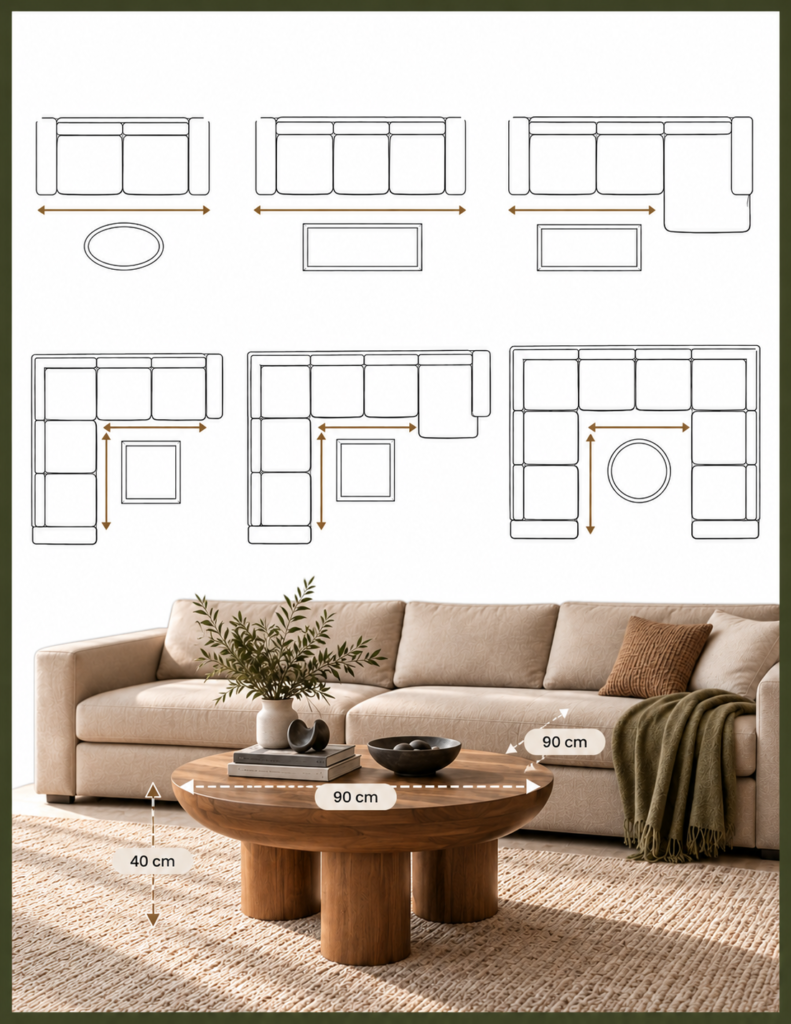
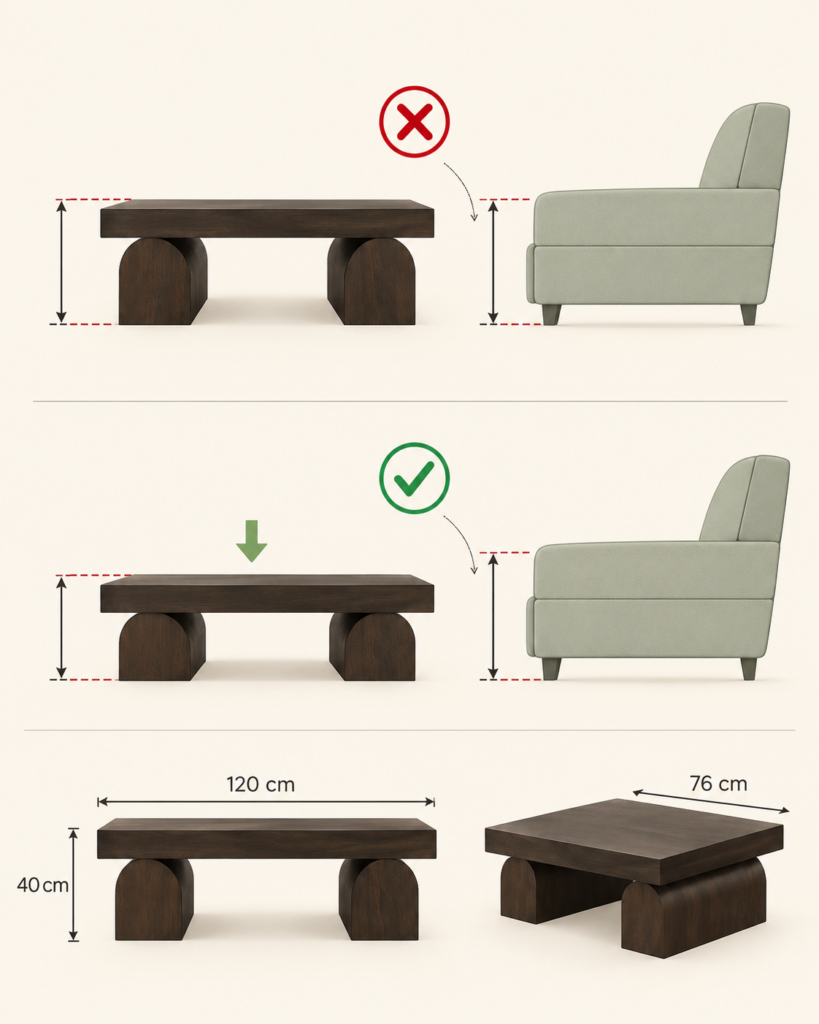
This square coffee table measures 90 × 90 × 40 cm (L × W × H) , a height that sits comfortably level with, or just a touch lower than, most sofa seats, so reaching for a cup, book, or remote never feels like a stretch.
The 90 × 90 cm footprint gives it a generous surface area while keeping a compact, balanced shape big enough to hold drinks, snacks, a tray, and a few decorative pieces all at once, without sprawling across the room. Because it’s square rather than long and rectangular, it holds its own visually in front of a sofa without needing to run the full width of the seating.
This size works particularly well with compact two-seaters, loveseats, and smaller living rooms, where a wide rectangular table would eat into walking space. Leave enough room between the sofa edge and the table to reach it comfortably, while still leaving space to stand up and move around without knocking your knees.
The 40 cm height also makes it a practical everyday surface low enough to stay visually connected to the seating, but tall enough that you’re not bending down every time you reach for something.
What Is the Ideal Coffee Table Height for a Sofa?
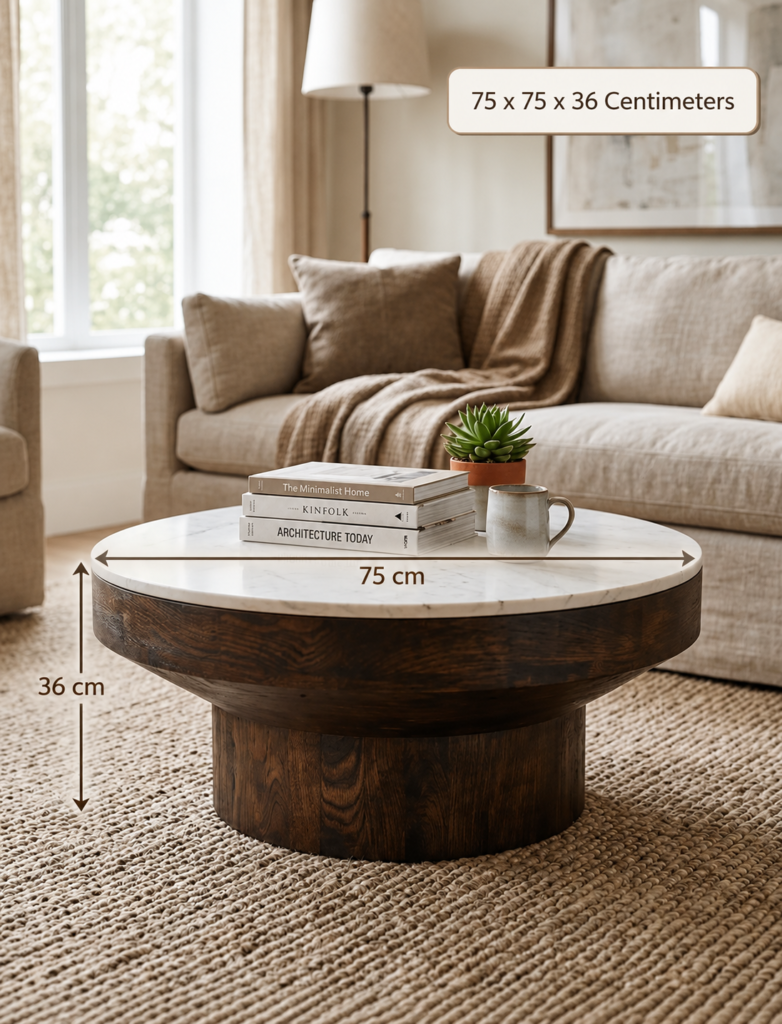
Start by measuring your own sofa rather than trusting a generic number. Measure from the floor straight up to the top of the seat cushion that’s your anchor point.
A coffee table set roughly level with the sofa seat, or slightly below it, usually feels the most comfortable when you’re sitting and reaching for a cup, book, or remote.
For example, a 90 × 90 × 45 cm (L × W × H) coffee table offers a practical height and a balanced square footprint for everyday living room use.
A small difference in height usually isn’t noticeable. What matters more is that the coffee table doesn’t tower over the sofa or sit so low that it becomes uncomfortable to use.
Should a Coffee Table Be the Same Height as the Sofa?
It can be, and in a lot of homes it’s actually the better choice especially if the table gets used often, for tea, snacks, a stack of books, or serving guests. Matching heights also gives the sofa-and-table combination a cleaner line instead of a stepped-down look.
Can a Coffee Table Be Lower Than the Sofa?
It can, and low-slung tables pair especially well with low-profile sofas and more relaxed, contemporary seating. Because a lower table keeps visual weight closer to the floor, the room tends to feel a bit more open.
The trade-off is convenience. A table styled low and sleek can look fantastic, but if you’re constantly reaching down for your phone or a mug, that look gets old fast. Sit with the idea before committing to it.nec ullamcorper mattis, pulvinar dapibus leo.
The Sofa-to-Coffee-Table Formula: Three Measurements That Matter
No single number decides whether a coffee table works. Consider height, length, and distance together and ideally alongside the rest of your seating arrangement, not as a standalone purchase. It’s worth glancing at your full living room furniture layout before locking in table dimensions, since the sofa, storage pieces, and side tables all pull on each other.
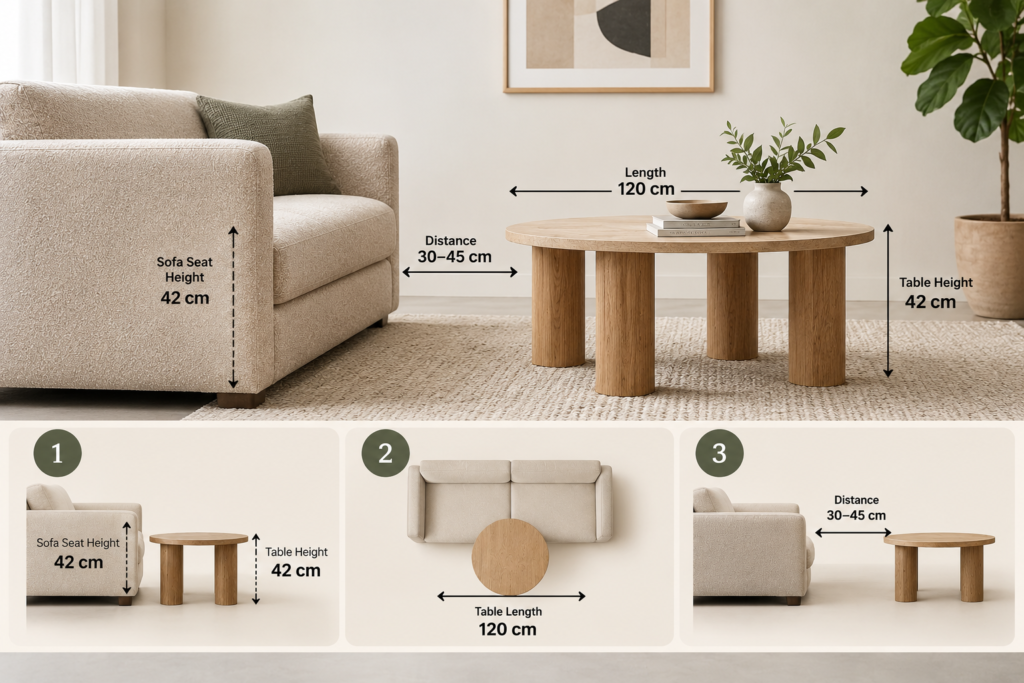
1. Height: Anchor to the Sofa Seat
Your sofa’s seat height is where this whole exercise begins. A very low table in front of a tall sofa can look oddly disconnected, while a low, laid-back sofa calls for something closer to the floor. Treat height less as a fixed measurement and more as a relationship between the two pieces.
2. Length: Keep It Proportionate
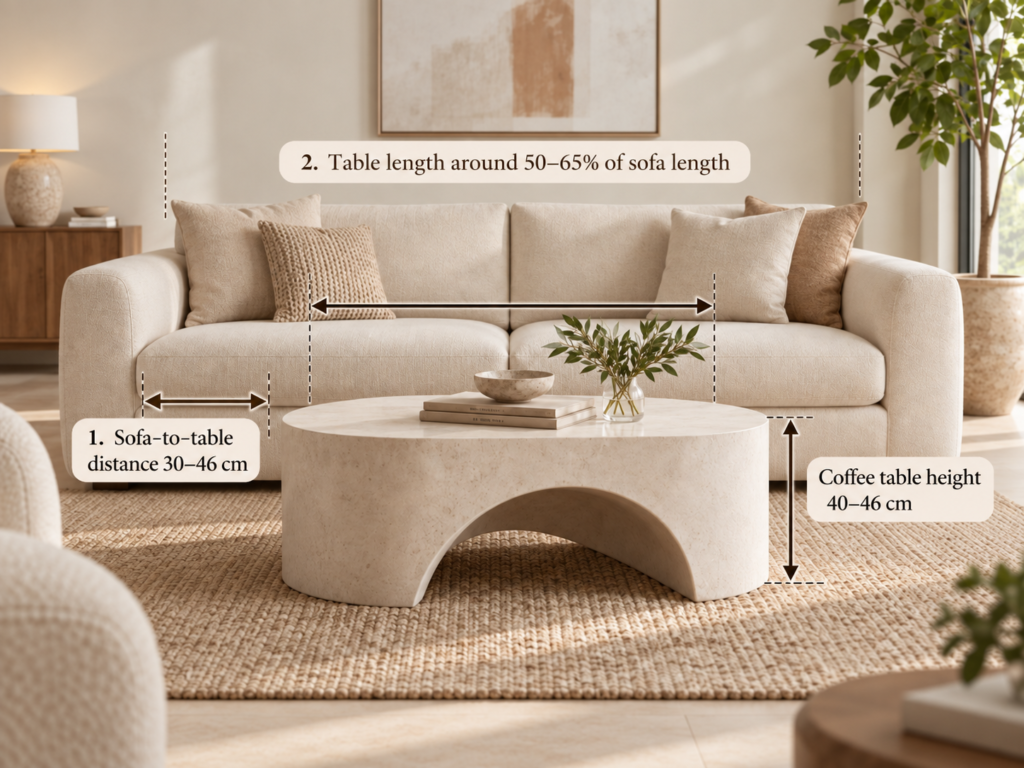
Too short, and the table looks like an afterthought in front of a big sofa. Too long, and it eats into the walking space. A reasonable starting range is 50–65% of your sofa’s length, so a 210 cm sofa points you toward something between 105 and 135 cm.
Shape plays a role here too. A 120 cm oval table reads lighter than a rectangular one of the same length, purely because the curved edges cut down on visual bulk.
3. Distance: Leave a Reach Zone
Somewhere around 30–46 cm between the sofa and table usually strikes the right balance: close enough to grab your cup, far enough that you’re not tripping over it every time you stand up. Tighter rooms may need to shave a few centimeters off that; bigger rooms have room to spare.
The Coffee Table Fit Matrix
| What to Measure | Practical Starting Point | Why It Matters | When to Adjust |
|---|---|---|---|
| Coffee table height | Close to sofa seat height, or slightly lower | Keeps it comfortable to reach and visually connected | Go lower for relaxed, low-profile seating |
| Coffee table length | Roughly 50–65% of sofa length | Keeps proportions balanced | Larger sectionals can carry a longer table |
| Table width | Enough surface without eating into circulation | Balances usability against open floor space | Go narrower in tighter rooms |
| Sofa-to-table gap | Around 30–46 cm | Gives reach without cramping legroom | Wider rooms can afford a bit more space |
| Shape | Match the seating geometry | Makes the layout feel intentional | Curved shapes help traffic flow |
| Low-profile table | Pair with relaxed, lower seating | Grounds a contemporary look | Go taller if you serve often |
| Compact-room footprint | Preserve visible floor space | Keeps small rooms from feeling packed | Round or oval shapes soften tight layouts |
Treat this as a sanity check, not a spec sheet you need to follow to the decimal.
How Far Should a Coffee Table Be From the Sofa?
Close enough to use, far enough that it’s not underfoot that’s really the whole brief. Push it in too tight, and you lose legroom every time you sit down; leave it too far, and you’re getting up just to grab the remote.
30–46 cm is workable for most living rooms, but check the far side of the table too if that’s part of your main walking path, you’ll want extra clearance there as well. The point isn’t squeezing the table into whatever gap exists; it’s keeping movement around the whole seating area smooth.
What Coffee Table Dimensions Work With Different Sofa Sizes?
“Two-seater” and “three-seater” are useful shorthand, but they don’t tell you exact dimensions always measure your own sofa before shopping.
Two-Seater Sofas
A compact two-seater usually pairs well with a smaller round, square, oval, or short rectangular table something that adds surface area without swallowing the open floor in front of it. In apartments especially, holding on to that visible floor space keeps the room from feeling boxed in.
Three-Seater Sofas
Longer sofas can carry a wider table. Start with the 50–65% length rule, then look at what’s sitting at either end of the sofa. If you’re also using side tables in the room, running the coffee table almost the full length of the sofa will make the layout feel dense; leave some breathing room between pieces.
L-Shaped or Sectional Sofas
Here, the open area inside the sectional matters more than the sofa’s total length. Round and square tables tend to work well in more contained seating zones; rectangular and oval shapes suit longer sectional layouts. Whichever you pick, it should fill the middle without blocking access to any of the seats.
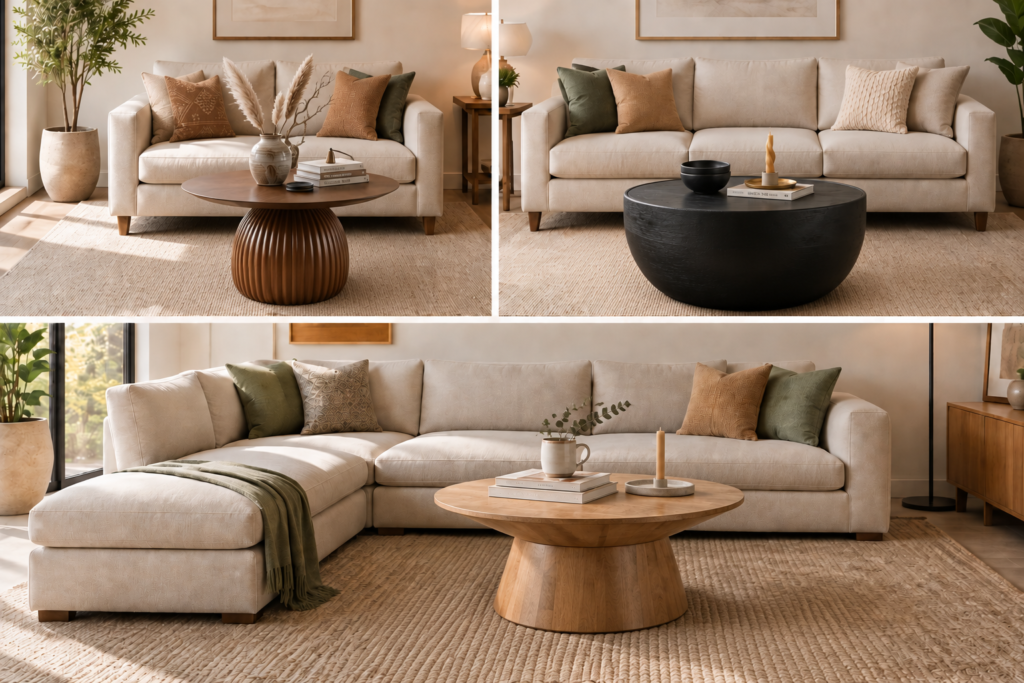
Does Coffee Table Shape Change the Ideal Dimensions?
Yes ,shape can make a table feel considerably bigger or smaller than its actual measurements suggest.
Rectangular tables follow the horizontal line of a long sofa and offer generous surface area a natural fit for conventional layouts where the sofa is the main event.
Round tables soften the room with no sharp corners, which helps when several seats face inward or people move around the table often.
Square tables suit symmetrical, sectional arrangements, though their width can eat up more floor space than expected measure carefully in a smaller room.
Oval tables borrow the length of a rectangle but keep the curved edges, giving a bigger surface without sacrificing easy movement around it.
ELVM Homes’ coffee table collection covers all four shapes across different materials and finishes, if you want to compare proportions side by side before deciding.
When Does a Low-Height Coffee Table Work Best?
Low tables suit rooms where the seating already has a relaxed profile deep-seated sofas with broad cushions tend to pair naturally with something closer to the floor, and the room reads more open as a result.
Just make sure “low” doesn’t turn into “inconvenient.” Sit on your sofa and picture reaching for a book or your phone before you commit a table can look striking and still be genuinely annoying to use every day.
Choosing Coffee Table Dimensions for a Small Living Room
Small rooms need more attention to circulation than large ones do. Start by measuring the actual open floor area in front of the sofa not the whole room, since chairs, doors, storage furniture, and walkways already eat into that space.
Think about how the coffee table relates to your TV unit too, especially if it sits between the sofa and the screen — leaving clearance around both keeps the centre of the room from feeling boxed in.
If floor space is genuinely tight, a compact coffee table with storage, or a set of small nesting tables, often works harder than one large table you get the surface area when you need it and reclaim the floor when you don’t. Round and oval shapes help here too, since curved edges make for smoother pathways than sharp corners.
One trick that actually works: mark the table’s footprint on the floor with tape and live with it for a few minutes sit, stand, walk around it. It tells you more than any measurement on a screen will.
Why Two Tables of the Same Height Can Feel Completely Different
Picture two coffee tables, both 40 cm tall. One measures 60 × 60 cm compact, almost upright in feel. The other is 120 × 60 cm at the exact same height, and reads as a much stronger horizontal presence in the room.
Same height, very different effect. Material changes this too a solid, block-like table feels heavier than a slim-framed one of similar size, and curved edges soften a large table in a way sharp corners never quite manage.
So the real answer sits in the combination: height, length, width, shape, material, and the space around it not any single number in isolation.
How to Measure Your Sofa Before Buying a Coffee Table
You don’t need any special tools for this just a tape measure and five minutes.
- Sofa seat height floor to the top of the seat cushion. This is your main reference point for table height.
- Available floor area the space between the sofa and whatever sits opposite it, accounting for the table, the gap around it, and any walkway beyond.
- Surrounding furniture chairs, side tables, storage units, doors anything the coffee table has to share space with.
- Test it on the floor tape or newspaper cut to the table’s footprint, then sit and walk around it before you buy.
- Sofa length measure the visible seating section, then use half to two-thirds of that as your starting range for table length.
Coffee Table Sizing Mistakes to Avoid
- Buying on looks alone. A gorgeous table that’s the wrong size is still the wrong table.
- Ignoring sofa seat height. People measure length obsessively and forget height entirely, but a big height mismatch throws off both the look and the everyday usability.
- Placing it too close to the sofa. Cramped legroom gets old fast.
- Going oversized. More surface area isn’t automatically better if it blocks movement around the room.
- Going too small. A tiny table in front of a wide sofa looks disconnected and isn’t much use to sit near.
- Forgetting shape. A rectangular and an oval table with near-identical dimensions occupy a room very differently; curved edges ease movement, and straight edges add structure.
Which Coffee Table Size Is Right for Your Living Room?
Three things worth checking before you finalise anything: is the height comfortable next to your sofa, is the size proportionate to your seating, and can people actually move around it without thinking twice?
If all three hold up, you’ve got the sizing right everything else, wood versus marble, colour, finish, is really just styling from here. A mango wood coffee table brings warmth into the room, a marble coffee table adds a cooler, more polished look, and wood-and-marble combinations split the difference nicely if you want a bit of both.
Find the Right Coffee Table for Your Sofa and Living Room
There isn’t one universal measurement that solves this it’s the relationship between height, sofa size, table length, shape, and the floor space you’re actually working with. Measure your sofa seat, size the table against it, check the gaps on either side, and the rest wood or marble, round or oval becomes a much easier call.
A coffee table sized right doesn’t just fill the middle of the room. It makes the whole seating area feel like it was actually planned, rather than just filled in.
FAQs About Coffee Table Height and Dimensions
What is the ideal coffee table height?
The ideal coffee table height is 40–46 cm (16–18 inches), matching the standard range most sofa seats fall into (43–48 cm / 17–19 inches). Aim for the table to sit level with your sofa seat or 2.5–5 cm (1–2 inches) lower this keeps reach comfortable without the table dominating the seating line.
Should a coffee table be lower than a sofa?
Yes. Most design guides recommend a coffee table sit 1–2 inches lower than the sofa seat rather than higher, since a taller table creates a visual barrier and makes reaching across it feel awkward. Matching height exactly also works, especially if the table sees frequent use for drinks or serving.
What is the 2/3 rule for coffee tables?
The 2/3 rule says a coffee table’s length shouldn’t exceed about two-thirds of the sofa’s length, with half the sofa length as the lower end of the range. For a 210 cm sofa, that puts the table roughly between 105 and 140 cm of enough surface without crowding the seating.
How far should a coffee table be from a sofa?
30–46 cm (12–18 inches) is the standard spacing between a sofa and coffee table. This leaves enough room to reach the table without leaning, while still allowing enough legroom to stand up or walk past comfortably.
Are round or oval coffee tables good for small living rooms?
Yes, generally. Round and oval tables remove sharp corners, which eases circulation and reduces visual bulk in a compact room compared to a rectangular or square table of the same surface area.
What size coffee table works with a three-seater sofa?
Three-seater sofas commonly run 180–230 cm long, so a coffee table at 50–65% of that, roughly 90–150 cm, is a solid starting point. Always measure the actual sofa first, since “three-seater” sizing varies a fair bit between brands.